Local SEO Playbook: Location Page Quality for India
Plan useful location pages, accurate business information and measurable local search improvements without multiplying near-identical city pages.
A practical starting point
A local SEO playbook begins with where the business actually serves customers and what it can reliably deliver there. Distinguish a physical office from a service area. A city page should not imply that a staffed location exists when it does not. Record the services, enquiry routes, availability and local constraints that matter to a prospective customer. For an India-focused site, consider language and location wording based on real audience needs.
In this guide
Table of contents
- A practical starting point
- Define the real service area
- Keep business details accurate and consistent
- Write pages around local decisions
- Validate discovery and mobile use
- Measure location cohorts and enquiry quality
- Visual implementation workbook
- Measurement and decision rules
- Continue your research
- Frequently asked questions
- Download the companion PDF
- Credits, sources and further review
- Need a search-growth plan for your website?
Define the real service area
A local SEO playbook begins with where the business actually serves customers and what it can reliably deliver there. Distinguish a physical office from a service area. A city page should not imply that a staffed location exists when it does not. Record the services, enquiry routes, availability and local constraints that matter to a prospective customer. For an India-focused site, consider language and location wording based on real audience needs.
Choose a small group of representative locations before expanding a template. A useful page can explain how the service works for that area, relevant delivery limits and the information needed to begin an enquiry. If there is nothing meaningful to say beyond replacing the city name, reconsider whether a separate page helps the customer.
Keep business details accurate and consistent
Review the business name, contact number, website links and location details wherever the company maintains them. Confirm the information against the business's actual operations rather than copying a directory listing that may be outdated. If the business uses a Google Business Profile, follow current eligibility and representation guidance. Do not create a profile or address claim solely because a keyword tool suggests demand in a city.
Make the contact path work on mobile. Check phone links, messaging links, opening or response expectations and the form fields needed for a useful enquiry. Keep important details as readable text. A visually polished page can still frustrate users if the contact button points to the wrong number or requires a script that fails to load.
Write pages around local decisions
Explain the relevant service and the questions a customer in that area needs answered. Use real examples when available and identify the limits of those examples. Avoid invented testimonials, branch claims or local project histories. Support the page with useful service details, a clear next step and links to the broader service explanation. A location name repeated in headings does not replace practical information.
Compare existing city and service pages before publishing. If their purpose is nearly identical, clarify which URL should own the main service answer and which should provide location-specific information. Use natural internal links between the two. Keep the hierarchy easy to navigate from the location hub and avoid creating an orphaned set of city pages.
Validate discovery and mobile use
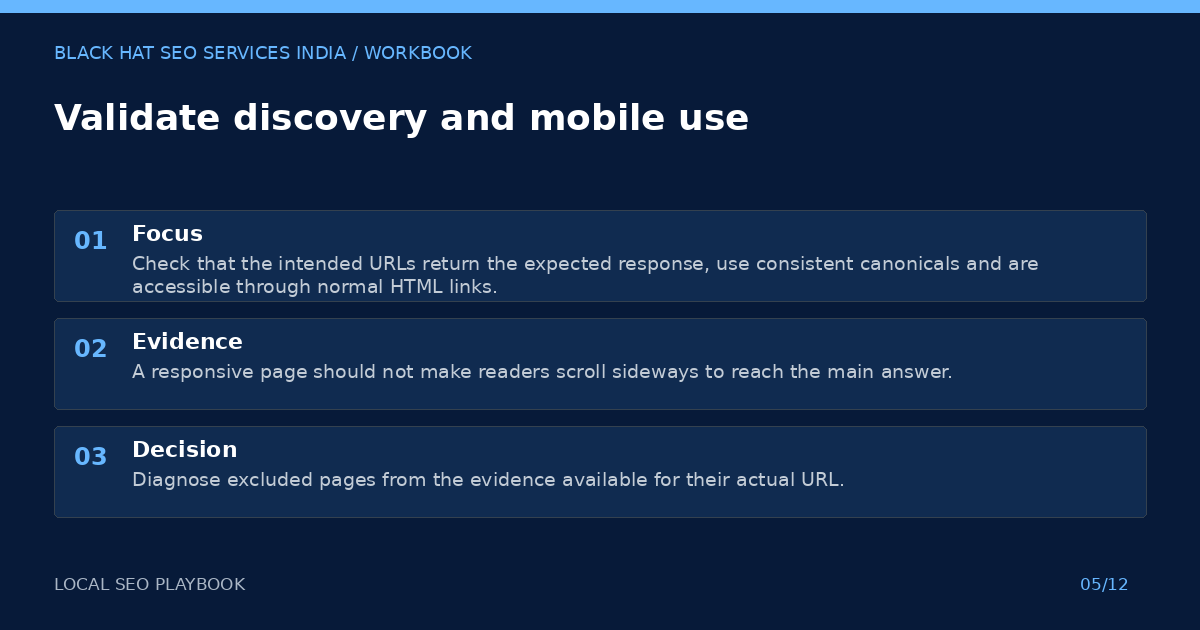
Check that the intended URLs return the expected response, use consistent canonicals and are accessible through normal HTML links. Inspect the mobile navigation, content width and contact controls. A responsive page should not make readers scroll sideways to reach the main answer. If tables need horizontal scrolling, keep that behavior inside the table container rather than across the whole page.
Review sitemap membership and index directives after deployment. Include only URLs intended for indexing and preserve a record of template changes. Treat crawl efficiency as a way to reduce ambiguity and wasted URL states, not as a promise that every submitted location page will be indexed. Diagnose excluded pages from the evidence available for their actual URL.
Measure location cohorts and enquiry quality
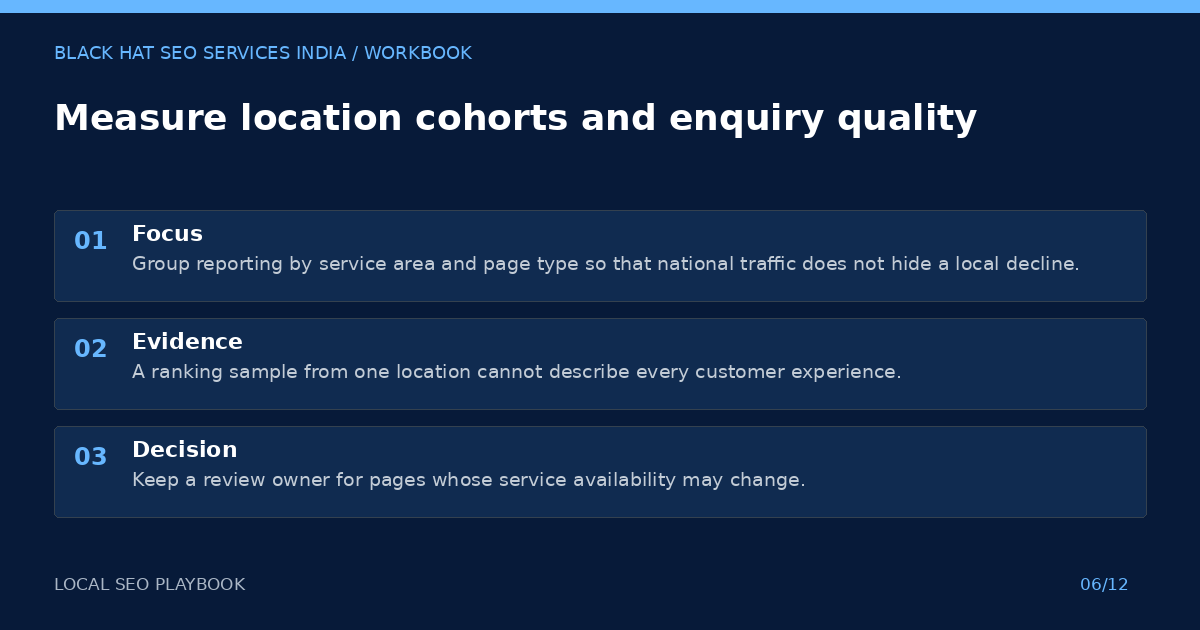
Group reporting by service area and page type so that national traffic does not hide a local decline. Review impressions, clicks, landing pages and enquiries when reliable attribution exists. A ranking sample from one location cannot describe every customer experience. Keep the observation location and device documented when using a rank tracker, and separate website performance from business-profile reporting.
Review the quality of the enquiries as well as the number. If a page attracts visitors outside the service boundary or creates the wrong expectation, improve the explanation before adding more cities. Expand only when the content model is useful, operational details are accurate and the team can maintain the information. Keep a review owner for pages whose service availability may change.
Visual implementation workbook
Use these six distinct worksheets to plan the work and retain an audit trail. Add your own URLs, findings and owners alongside each stage.
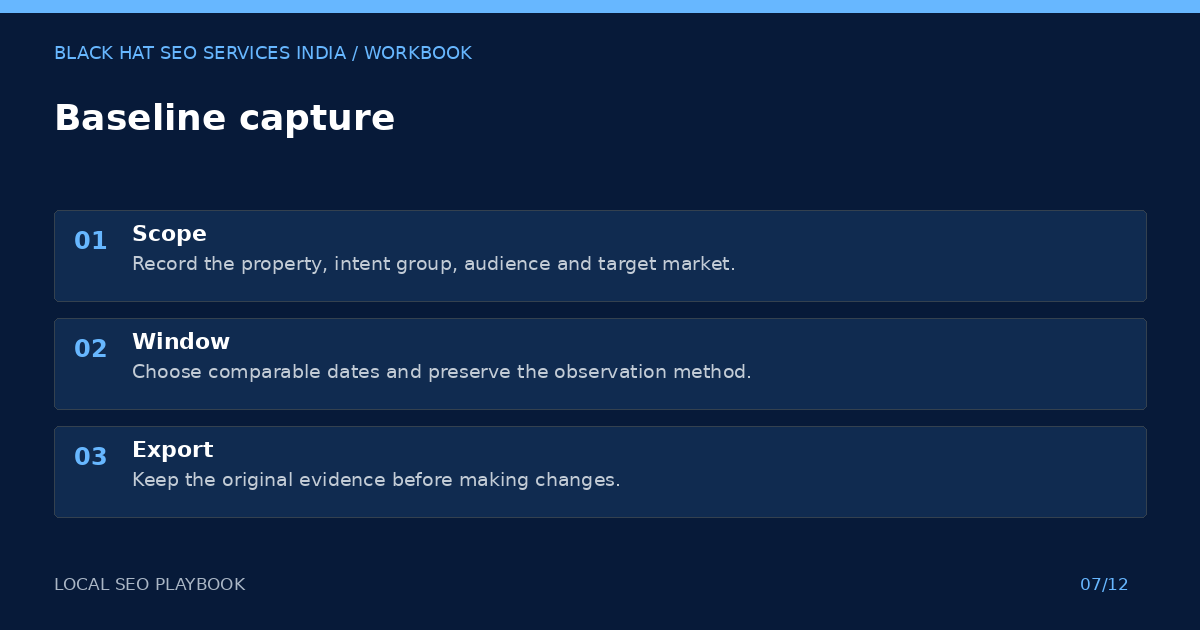
Scope: Record the property, intent group, audience and target market. Window: Choose comparable dates and preserve the observation method. Export: Keep the original evidence before making changes.
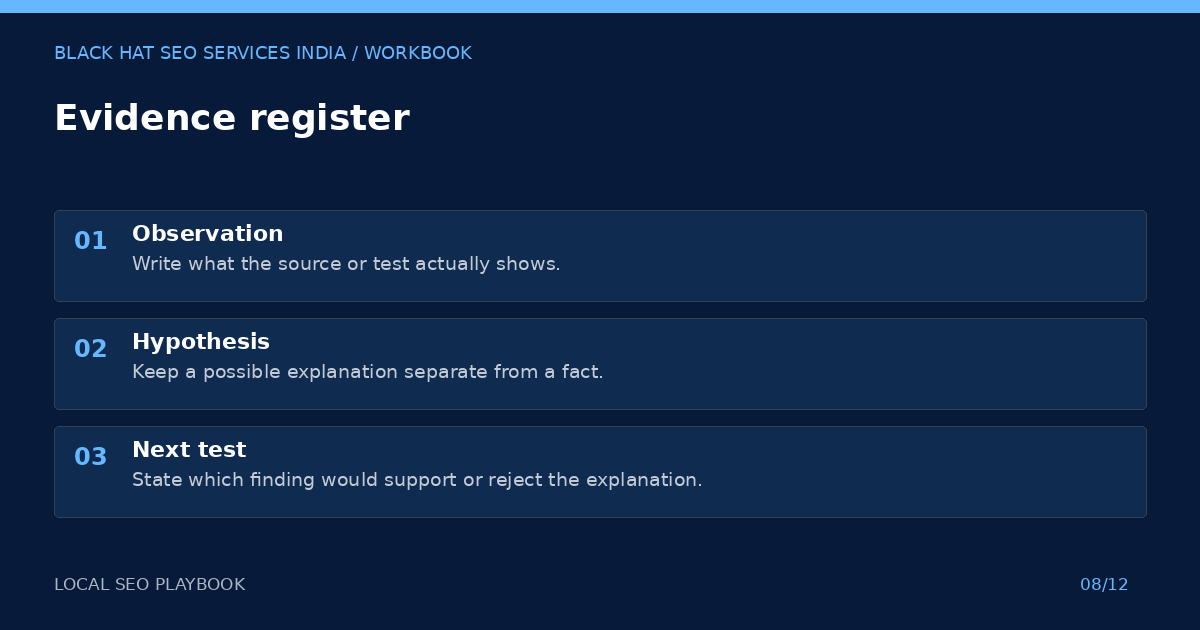
Observation: Write what the source or test actually shows. Hypothesis: Keep a possible explanation separate from a fact. Next test: State which finding would support or reject the explanation.
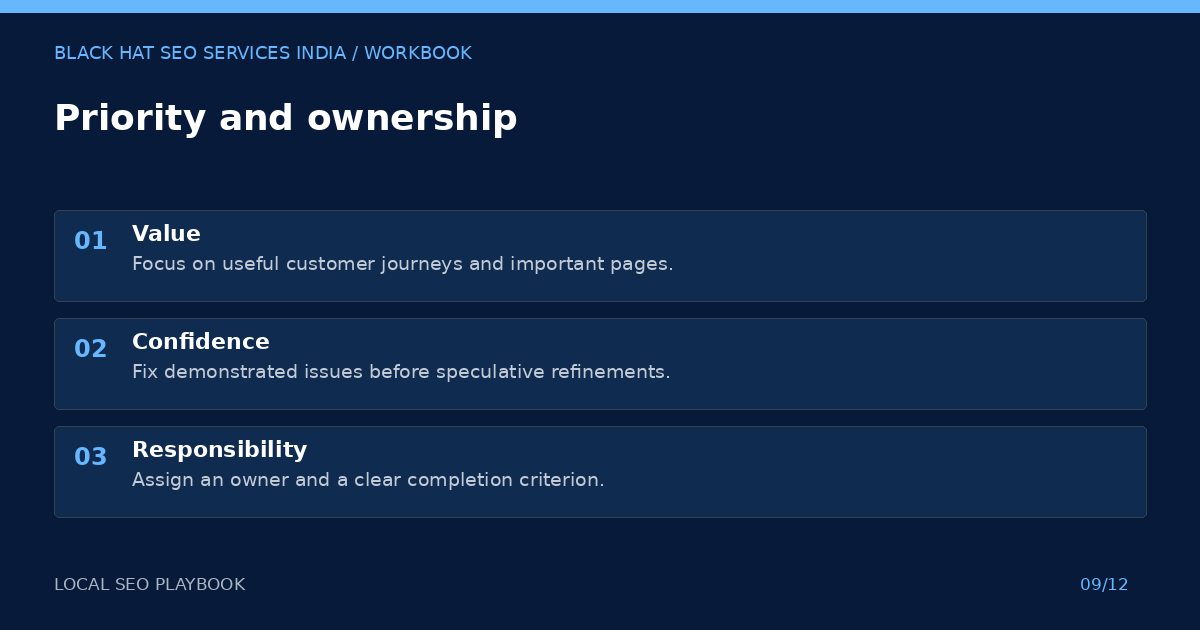
Value: Focus on useful customer journeys and important pages. Confidence: Fix demonstrated issues before speculative refinements. Responsibility: Assign an owner and a clear completion criterion.
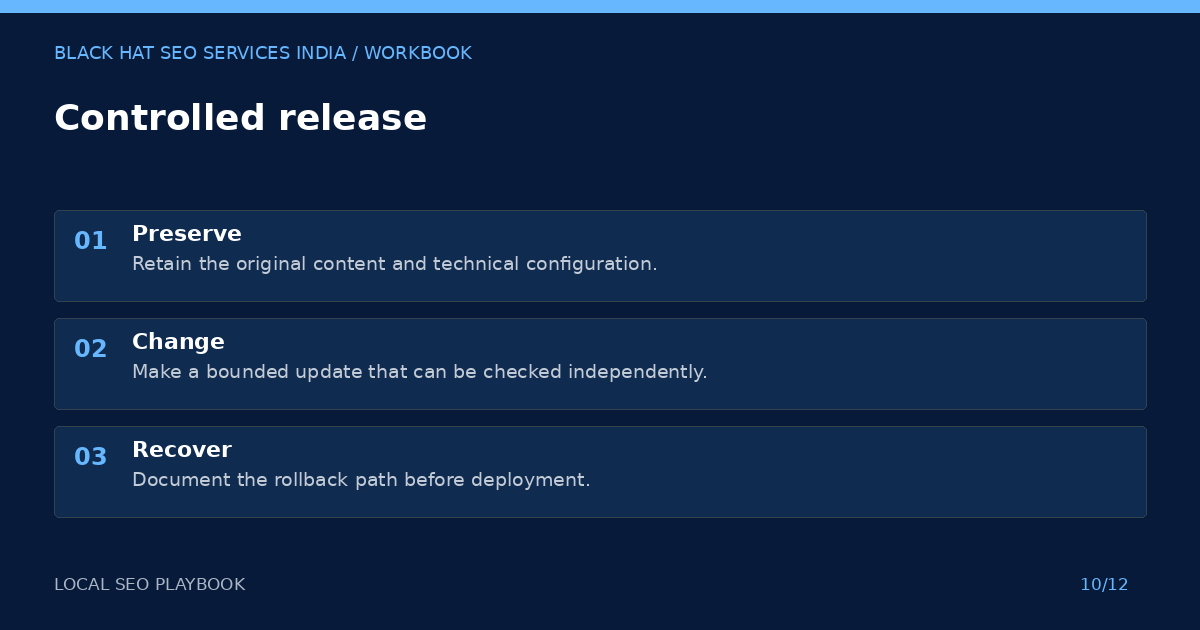
Preserve: Retain the original content and technical configuration. Change: Make a bounded update that can be checked independently. Recover: Document the rollback path before deployment.
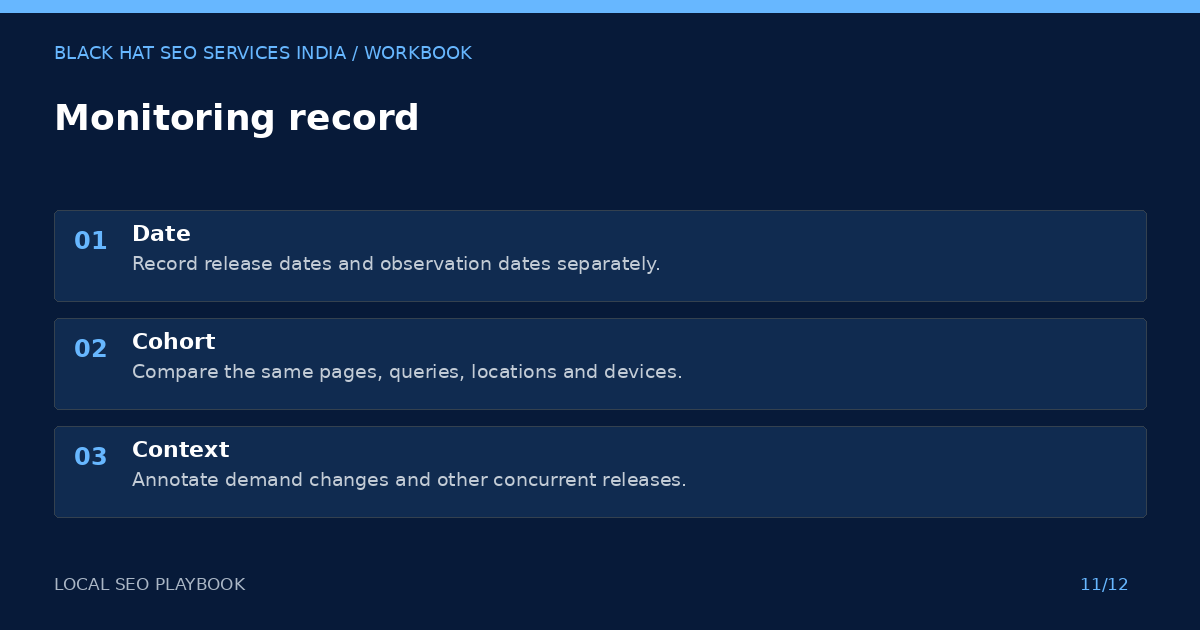
Date: Record release dates and observation dates separately. Cohort: Compare the same pages, queries, locations and devices. Context: Annotate demand changes and other concurrent releases.
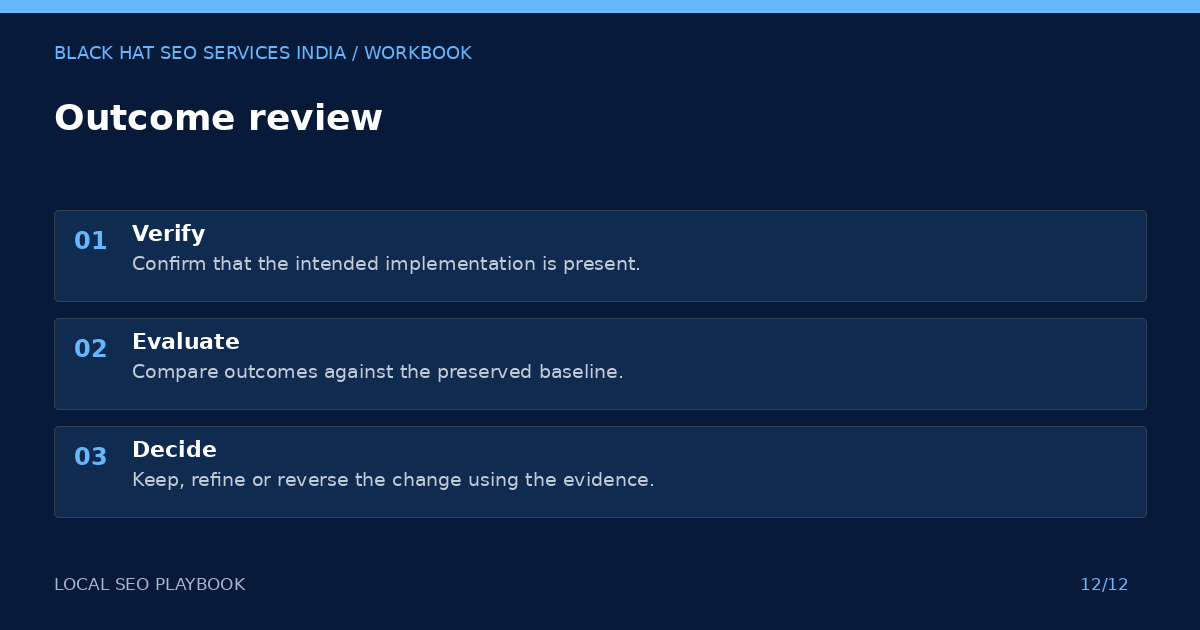
Verify: Confirm that the intended implementation is present. Evaluate: Compare outcomes against the preserved baseline. Decide: Keep, refine or reverse the change using the evidence.
Measurement and decision rules
| Signal | Interpretation | Next review |
|---|---|---|
| Impressions | Recorded exposure for the selected report scope | Compare the same query and page groups |
| Clicks | Recorded visits initiated from search results | Review result context and destination usefulness |
| CTR | Clicks divided by impressions | Inspect intent and result-layout changes |
| Average position | An aggregate across recorded impressions | Avoid treating a sitewide average as one fixed rank |
Search measurement glossary
- Impressions
- The number of times a result was shown in the selected Search Console report.
- Clicks
- The clicks recorded for results in the same Search Console report scope.
Frequently asked questions
What is the first step for local seo playbook?
A local SEO playbook begins with where the business actually serves customers and what it can reliably deliver there.
Should every keyword have a separate page?
No. Group variations that serve the same reader task. Create a new URL when the audience or purpose is meaningfully different.
Which evidence should I preserve?
Keep the original exports, observation dates, affected URLs, implementation log and review decision.
How do I judge an improvement?
Use a consistent baseline and page/query cohort, then distinguish completed implementation from observed search outcomes.
Does this guarantee a ranking position?
No. Use accountable work, accurate reporting and useful page content as the basis for decisions.
Download the companion PDF
Keep the complete guide, checklists and implementation workbook in a portable format.
Credits, sources and further review
Image credit and reuse
These twelve original instructional graphics were prepared for Black Hat SEO Services India. Credit: Black Hat SEO Services India — original guide artwork. For permission to reproduce or adapt a graphic, identify the image and contact the agency. No third-party stock photography is included.
Request image reuse permission
Official references
Need a search-growth plan for your website?
Share the domain, priority market and commercial goal. The first conversation can focus on where visibility is being lost, where demand exists and which changes deserve priority.