Competitive SEO Analysis: From Evidence to Priorities
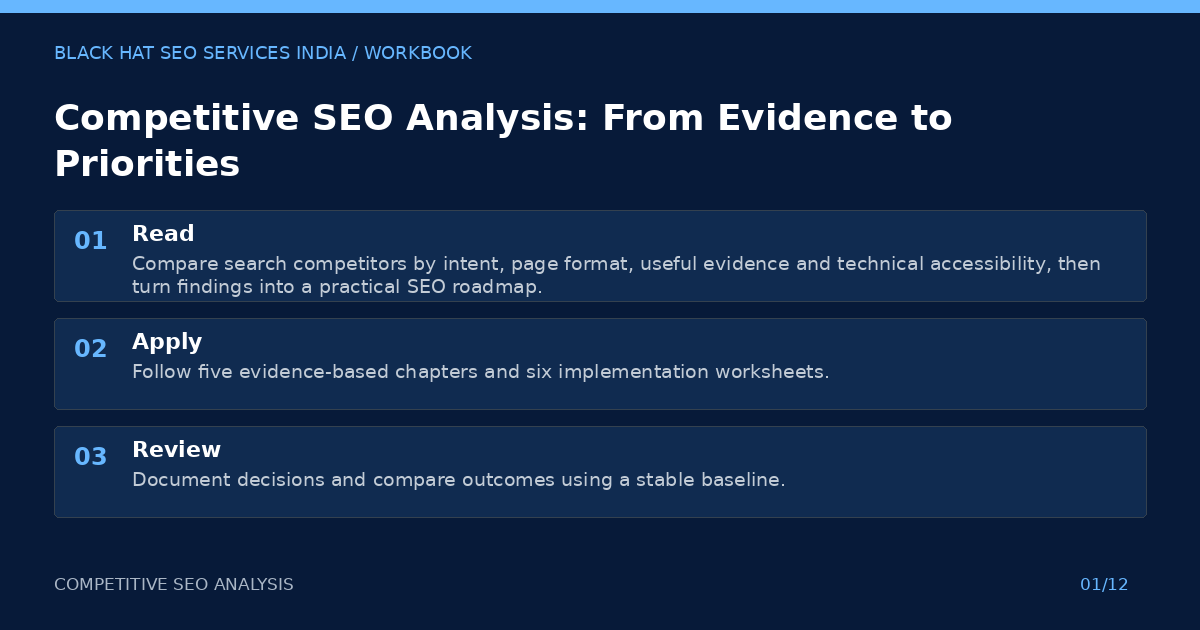
Compare search competitors by intent, page format, useful evidence and technical accessibility, then turn findings into a practical SEO roadmap.
A practical starting point
Competitive SEO analysis starts with the pages visible for the questions your customers ask. Your business competitors and your search competitors may differ. A marketplace, a publisher or a local directory can compete for attention even when it does not sell the same service. Group queries by the task behind them and record which page formats appear repeatedly. Keep country, language and device consistent when comparing results.
In this guide
Table of contents
- A practical starting point
- Find the competitors for each search task
- Separate replicable strengths from historical advantages
- Compare intent and information architecture
- Turn observations into bounded experiments
- Measure the effect without claiming certainty
- Visual implementation workbook
- Measurement and decision rules
- Continue your research
- Frequently asked questions
- Download the companion PDF
- Credits, sources and further review
- Need a search-growth plan for your website?
Find the competitors for each search task
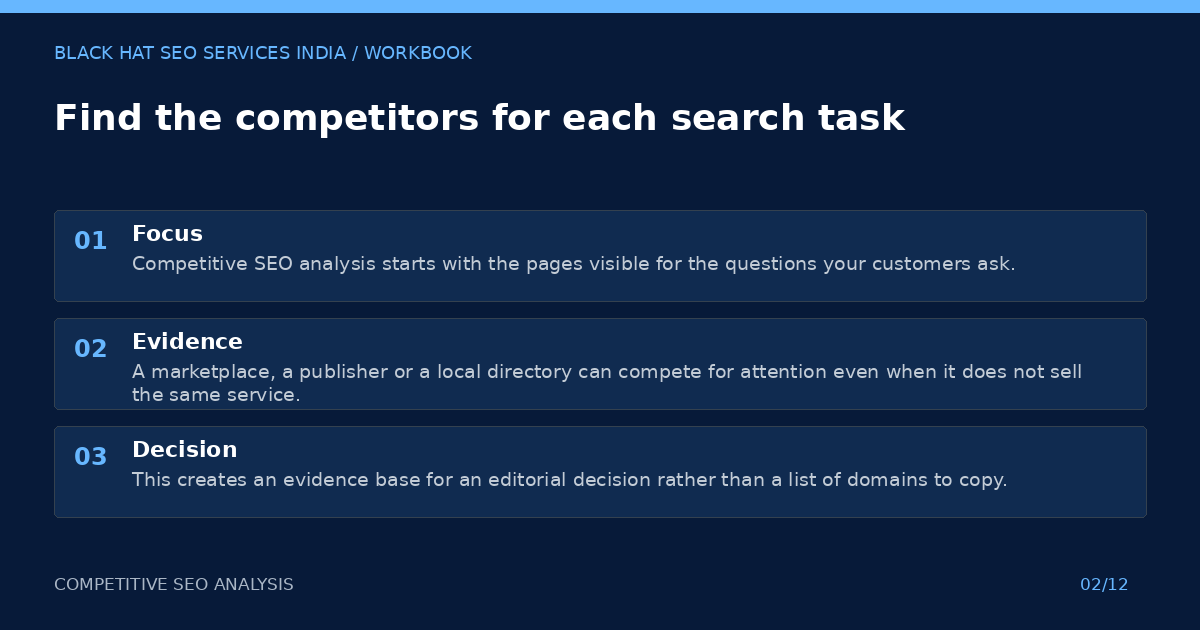
Competitive SEO analysis starts with the pages visible for the questions your customers ask. Your business competitors and your search competitors may differ. A marketplace, a publisher or a local directory can compete for attention even when it does not sell the same service. Group queries by the task behind them and record which page formats appear repeatedly. Keep country, language and device consistent when comparing results.
Do not create one competitor list for every service. A company may be strong for definitions and weak for purchase comparisons, or visible nationally but less relevant in a city-specific result. Record the query group, the competing URL and the reason that page appears useful to the searcher. This creates an evidence base for an editorial decision rather than a list of domains to copy.
Separate replicable strengths from historical advantages
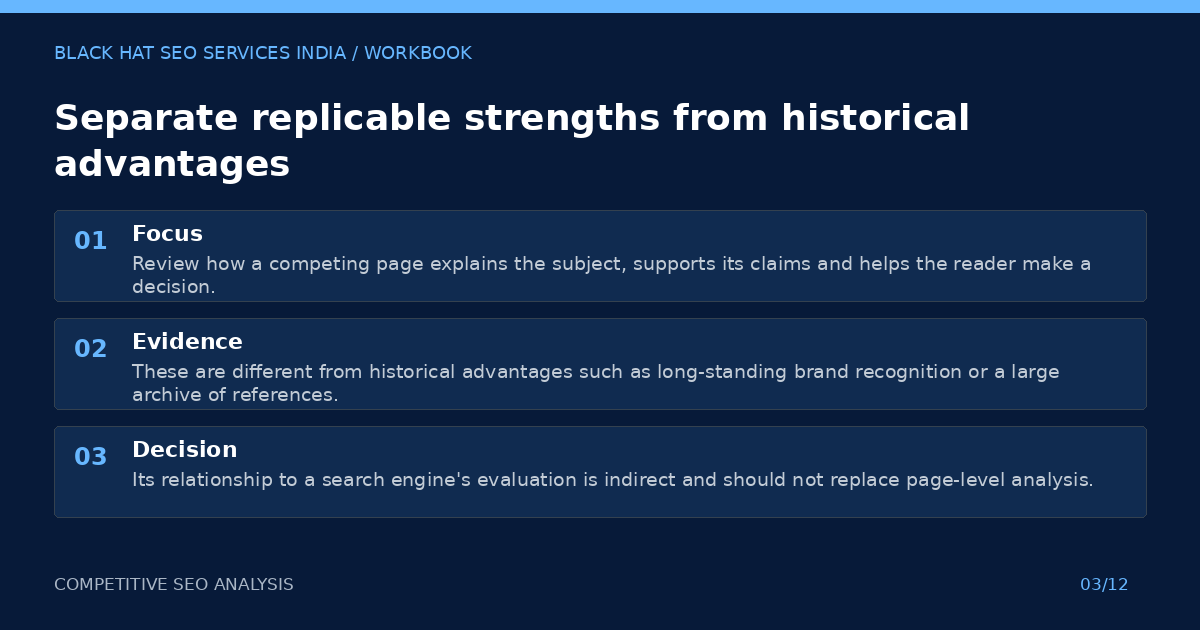
Review how a competing page explains the subject, supports its claims and helps the reader make a decision. Look for useful examples, original evidence, clear comparison criteria and accessible navigation. These are different from historical advantages such as long-standing brand recognition or a large archive of references. A young website cannot reproduce those historical signals simply by matching a page's headings or word count.
Record what you can improve directly and what requires longer-term work. A missing implementation example can be addressed in a draft; a lack of recognized expertise may require subject review, original research and sustained distribution. Avoid using a third-party authority score as the sole explanation for a ranking. Its relationship to a search engine's evaluation is indirect and should not replace page-level analysis.
Compare intent and information architecture
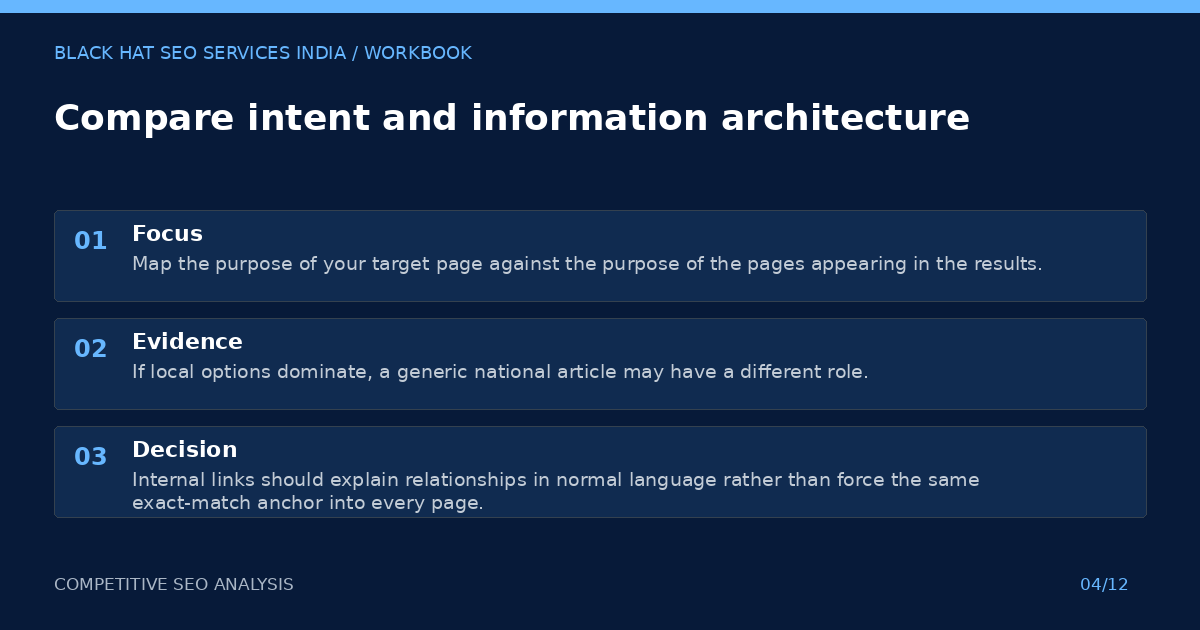
Map the purpose of your target page against the purpose of the pages appearing in the results. If searchers want a practical comparison, a short service pitch may leave their main question unanswered. If local options dominate, a generic national article may have a different role. Examine whether important supporting questions belong on the same page or in a distinct guide with a clear internal link.
Check your existing content inventory before proposing new URLs. Several near-identical pages can make ownership of the topic unclear. Differentiate useful pages by audience and task, and consolidate only when the evidence supports it. Internal links should explain relationships in normal language rather than force the same exact-match anchor into every page.
Turn observations into bounded experiments
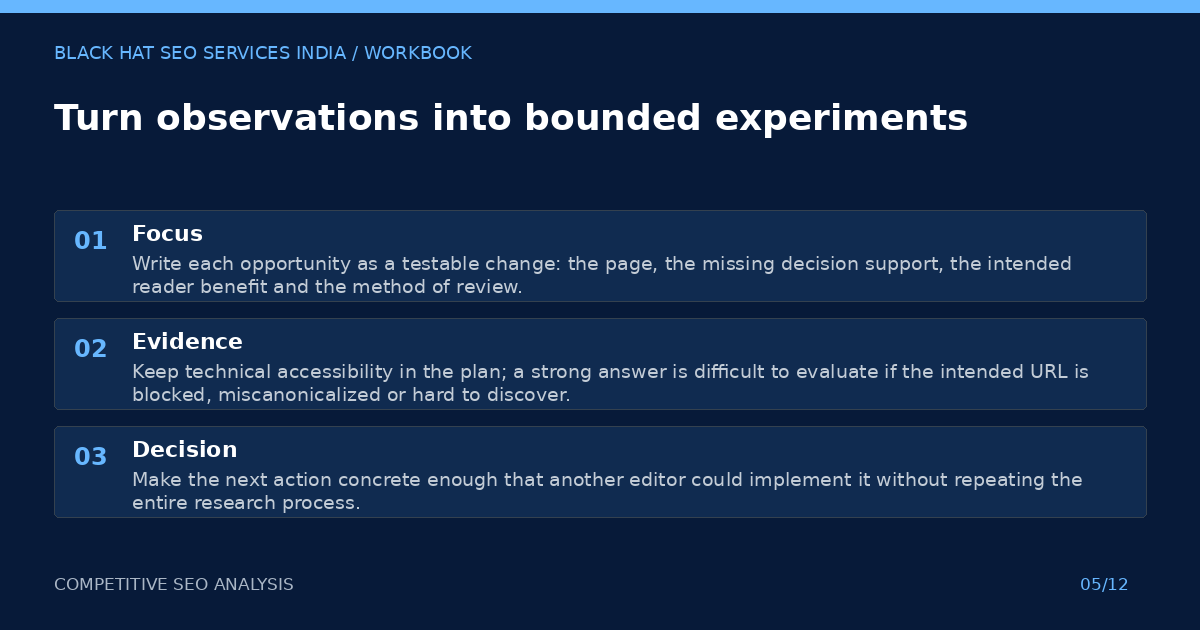
Write each opportunity as a testable change: the page, the missing decision support, the intended reader benefit and the method of review. Prioritize high-value gaps with strong evidence and reasonable implementation effort. Keep technical accessibility in the plan; a strong answer is difficult to evaluate if the intended URL is blocked, miscanonicalized or hard to discover. Assign one owner to each change and preserve the initial page state.
Use competitor pages to identify missing decisions rather than to reproduce their wording. An original example based on your own process is more useful than a paraphrase of a rival's checklist. Ask a reviewer to verify factual claims and explain where conclusions rely on inference. Make the next action concrete enough that another editor could implement it without repeating the entire research process.
Measure the effect without claiming certainty
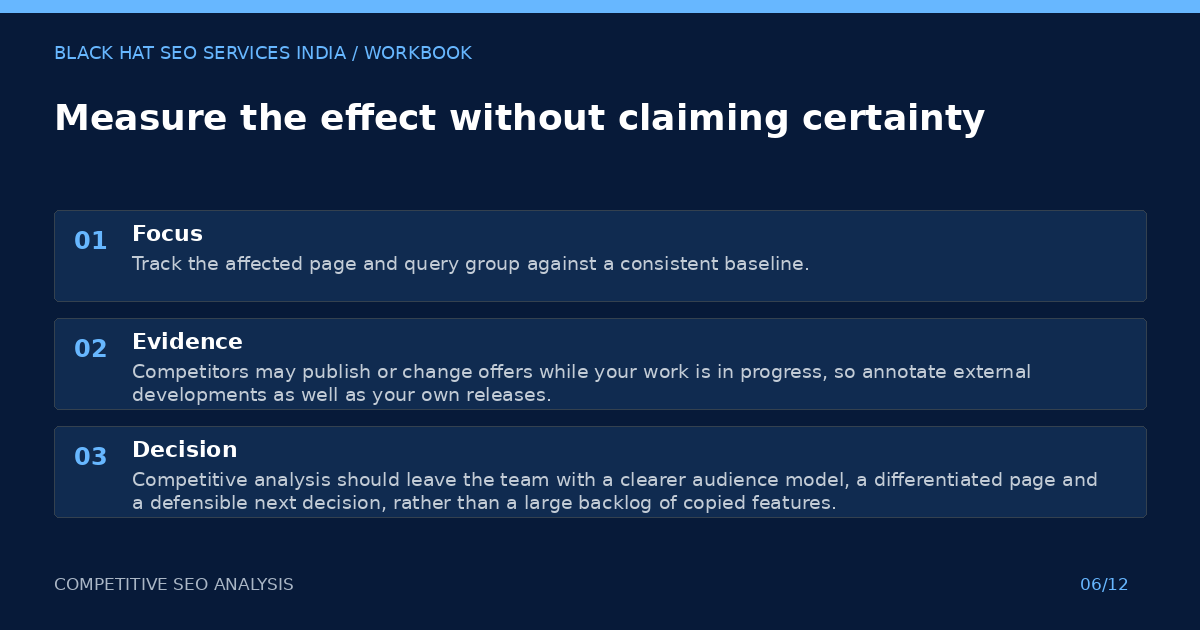
Track the affected page and query group against a consistent baseline. Review impressions, clicks, selected landing pages and useful business outcomes where available. Competitors may publish or change offers while your work is in progress, so annotate external developments as well as your own releases. A before-and-after change is an observation; it does not prove that one edit caused the difference.
At the next review, identify which hypothesis gained support and which did not. Keep the roadmap open to revision when the result set changes or the original assumption proves weak. Competitive analysis should leave the team with a clearer audience model, a differentiated page and a defensible next decision, rather than a large backlog of copied features.
Visual implementation workbook
Use these six distinct worksheets to plan the work and retain an audit trail. Add your own URLs, findings and owners alongside each stage.
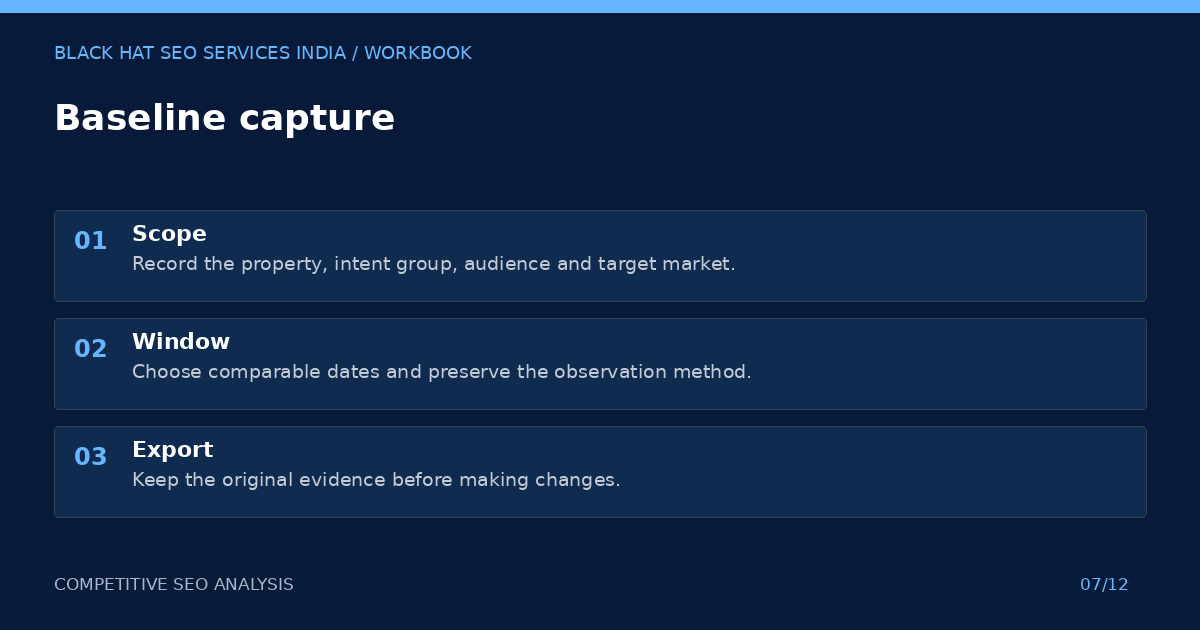
Scope: Record the property, intent group, audience and target market. Window: Choose comparable dates and preserve the observation method. Export: Keep the original evidence before making changes.
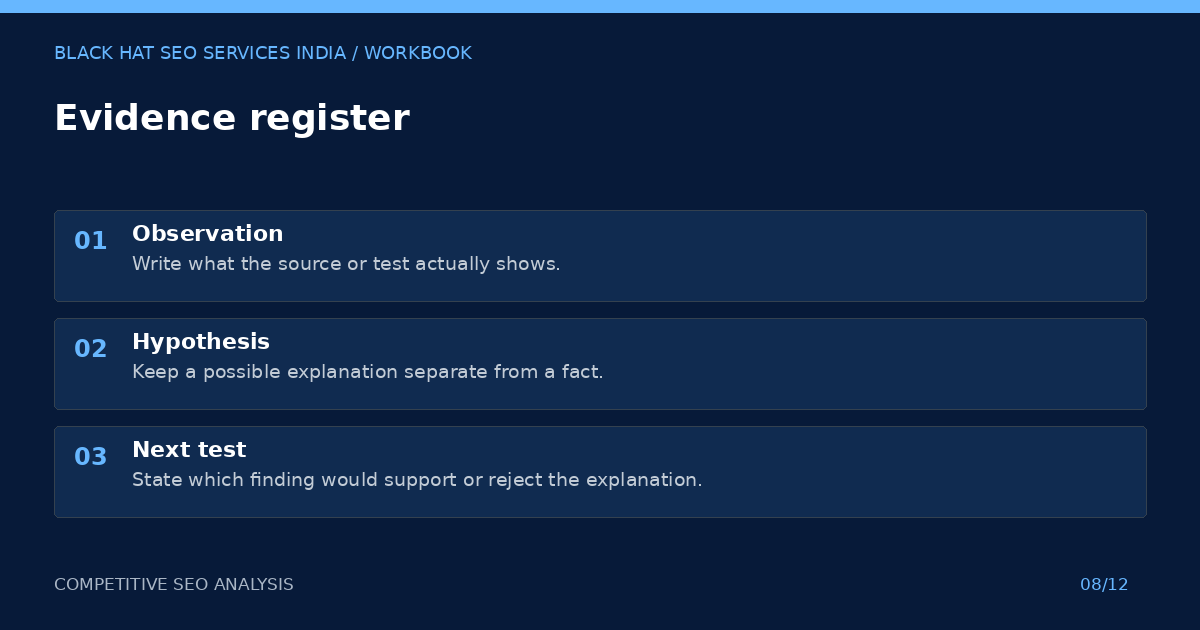
Observation: Write what the source or test actually shows. Hypothesis: Keep a possible explanation separate from a fact. Next test: State which finding would support or reject the explanation.
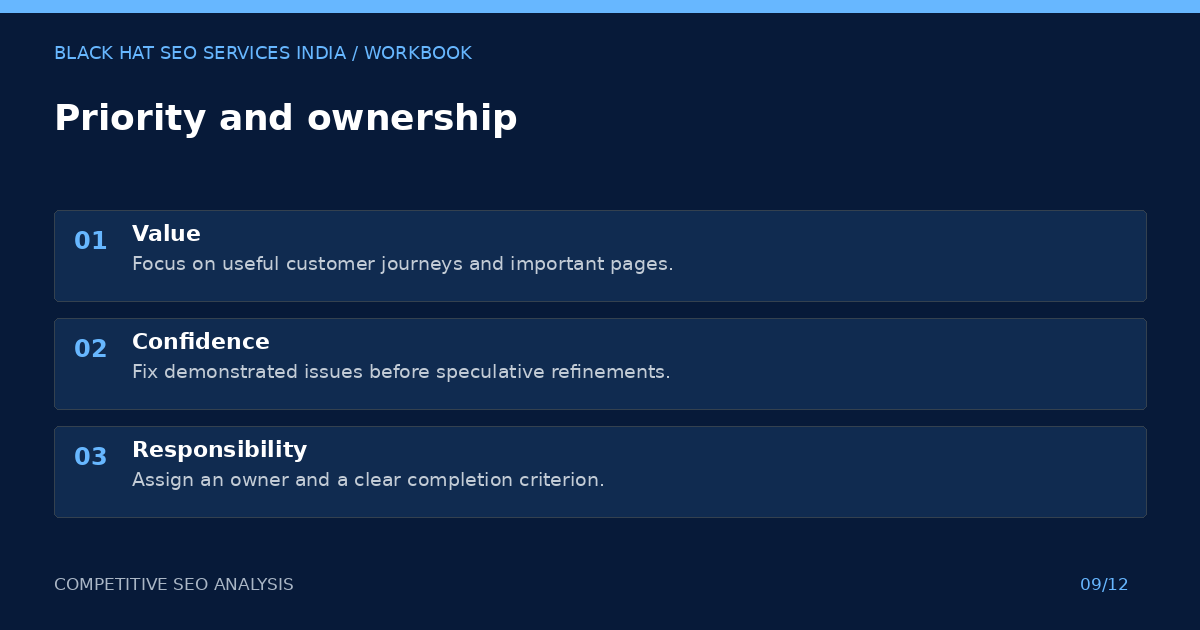
Value: Focus on useful customer journeys and important pages. Confidence: Fix demonstrated issues before speculative refinements. Responsibility: Assign an owner and a clear completion criterion.
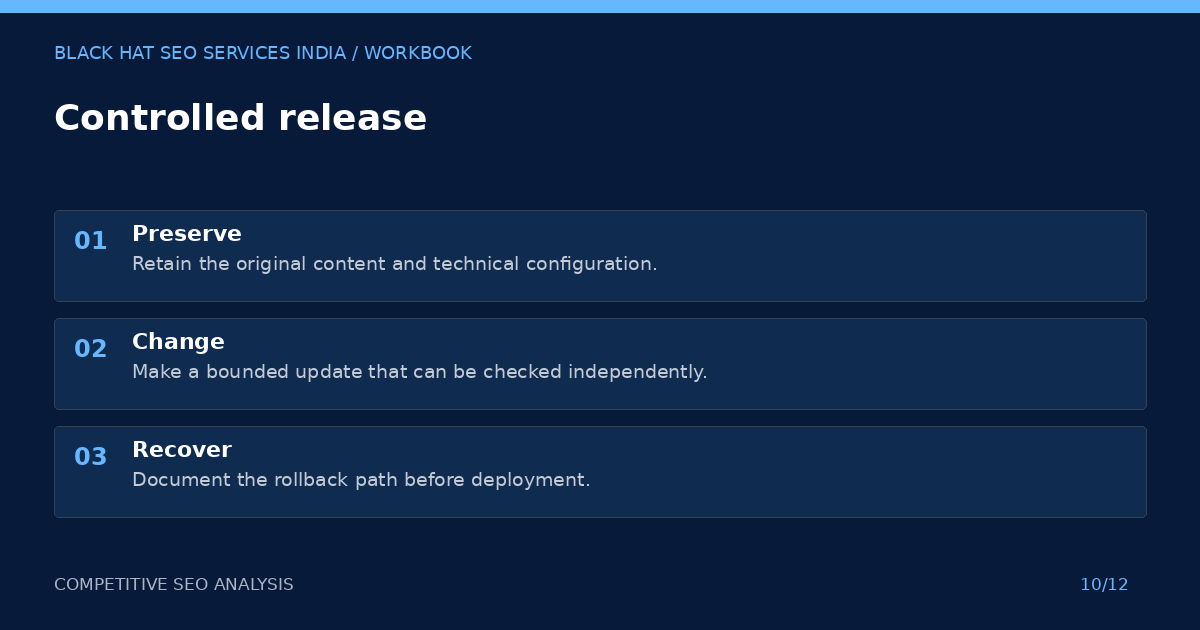
Preserve: Retain the original content and technical configuration. Change: Make a bounded update that can be checked independently. Recover: Document the rollback path before deployment.
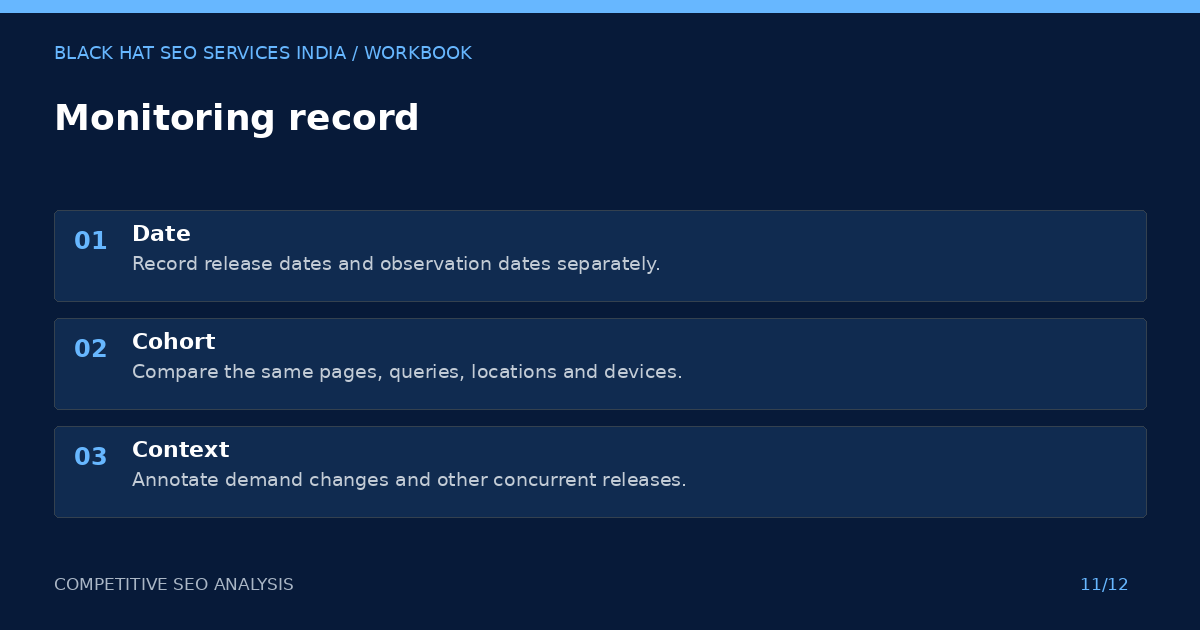
Date: Record release dates and observation dates separately. Cohort: Compare the same pages, queries, locations and devices. Context: Annotate demand changes and other concurrent releases.
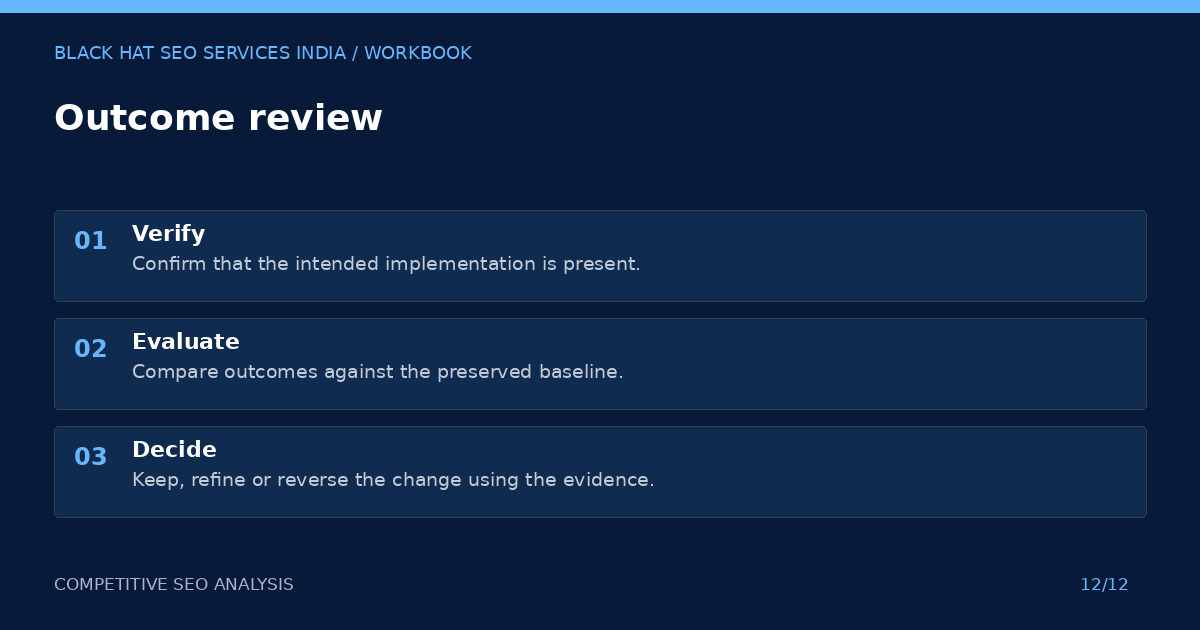
Verify: Confirm that the intended implementation is present. Evaluate: Compare outcomes against the preserved baseline. Decide: Keep, refine or reverse the change using the evidence.
Measurement and decision rules
| Signal | Interpretation | Next review |
|---|---|---|
| Impressions | Recorded exposure for the selected report scope | Compare the same query and page groups |
| Clicks | Recorded visits initiated from search results | Review result context and destination usefulness |
| CTR | Clicks divided by impressions | Inspect intent and result-layout changes |
| Average position | An aggregate across recorded impressions | Avoid treating a sitewide average as one fixed rank |
Search measurement glossary
- Impressions
- The number of times a result was shown in the selected Search Console report.
- Clicks
- The clicks recorded for results in the same Search Console report scope.
Frequently asked questions
What is the first step for competitive seo analysis?
Competitive SEO analysis starts with the pages visible for the questions your customers ask.
Should every keyword have a separate page?
No. Group variations that serve the same reader task. Create a new URL when the audience or purpose is meaningfully different.
Which evidence should I preserve?
Keep the original exports, observation dates, affected URLs, implementation log and review decision.
How do I judge an improvement?
Use a consistent baseline and page/query cohort, then distinguish completed implementation from observed search outcomes.
Does this guarantee a ranking position?
No. Use accountable work, accurate reporting and useful page content as the basis for decisions.
Download the companion PDF
Keep the complete guide, checklists and implementation workbook in a portable format.
Credits, sources and further review
Image credit and reuse
These twelve original instructional graphics were prepared for Black Hat SEO Services India. Credit: Black Hat SEO Services India — original guide artwork. For permission to reproduce or adapt a graphic, identify the image and contact the agency. No third-party stock photography is included.
Request image reuse permission
Official references
Need a search-growth plan for your website?
Share the domain, priority market and commercial goal. The first conversation can focus on where visibility is being lost, where demand exists and which changes deserve priority.