Content Gap Analysis SEO: Improve Existing Pages First
Find missing search tasks, map them to existing pages and choose between improving, differentiating or creating content.
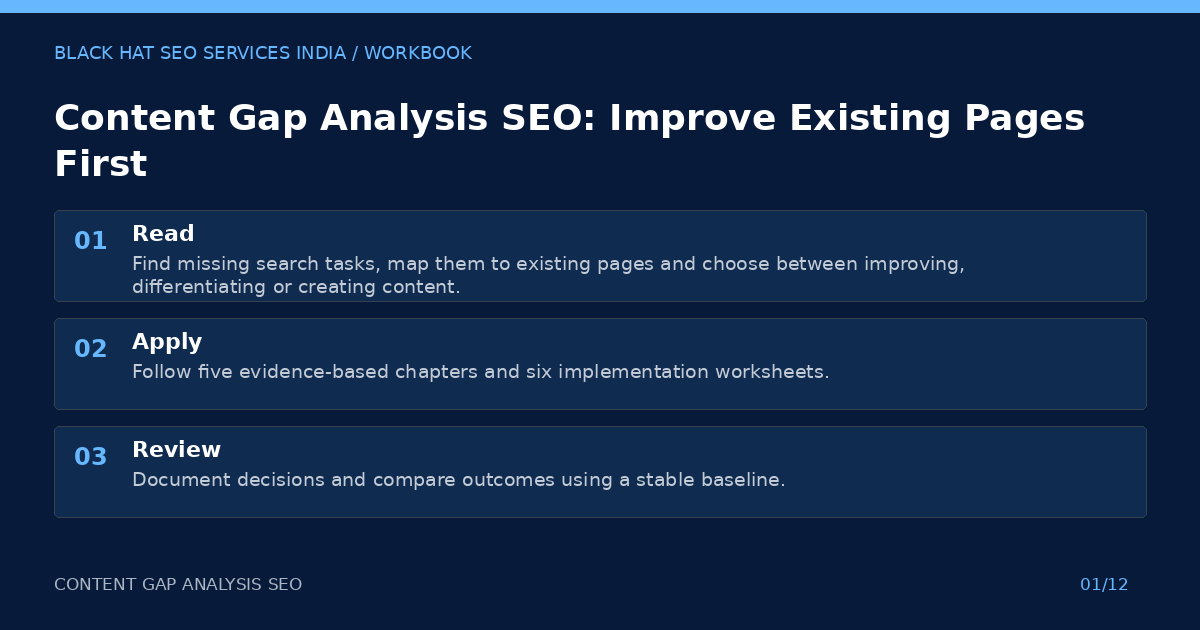
A practical starting point
Content gap analysis SEO is useful when a gap means a question your audience cannot currently answer using your website. A keyword absent from a draft is not automatically a content gap. Start with the reader's decision, the evidence needed and the page that should own the answer. Group close keyword variations into intent clusters before considering new URLs. This avoids creating several thin articles that repeat the same promise.
In this guide
Table of contents
- A practical starting point
- Define a gap as an unanswered reader task
- Use first-party evidence to find weak coverage
- Choose improve, differentiate or create
- Build a reviewable editorial brief
- Measure usefulness after the update
- Visual implementation workbook
- Measurement and decision rules
- Continue your research
- Frequently asked questions
- Download the companion PDF
- Credits, sources and further review
- Need a search-growth plan for your website?
Define a gap as an unanswered reader task
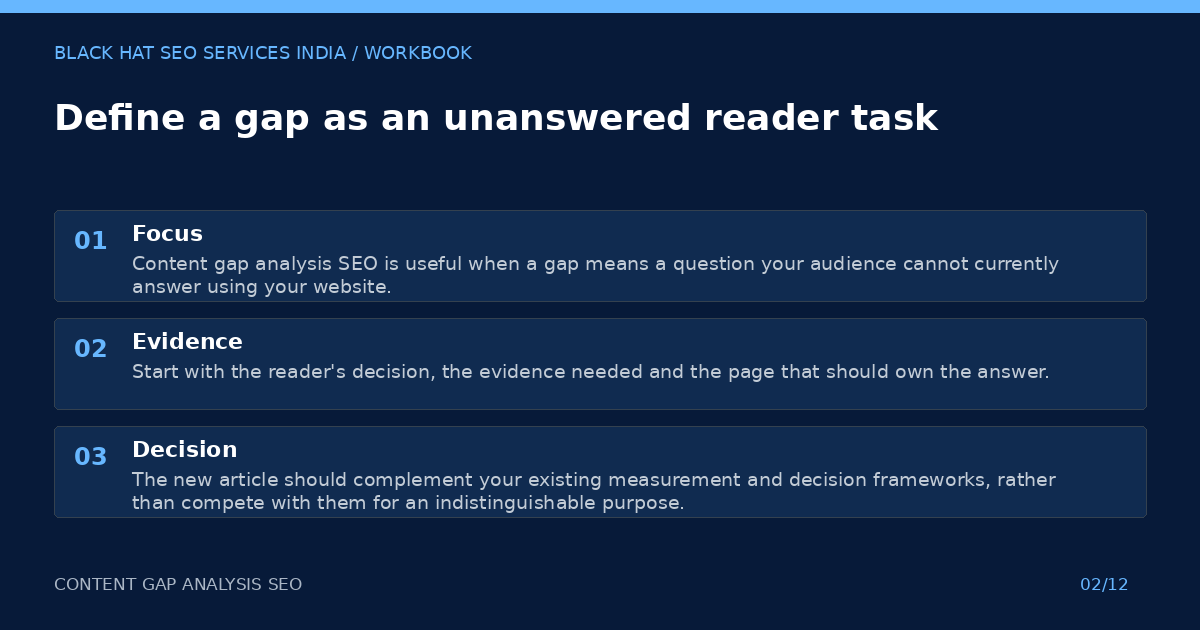
Content gap analysis SEO is useful when a gap means a question your audience cannot currently answer using your website. A keyword absent from a draft is not automatically a content gap. Start with the reader's decision, the evidence needed and the page that should own the answer. Group close keyword variations into intent clusters before considering new URLs. This avoids creating several thin articles that repeat the same promise.
Review the existing content inventory and name the role of each page. A definition, a measurement guide and a service evaluation can support one topic while answering different tasks. Keep those boundaries explicit. The new article should complement your existing measurement and decision frameworks, rather than compete with them for an indistinguishable purpose.
Use first-party evidence to find weak coverage
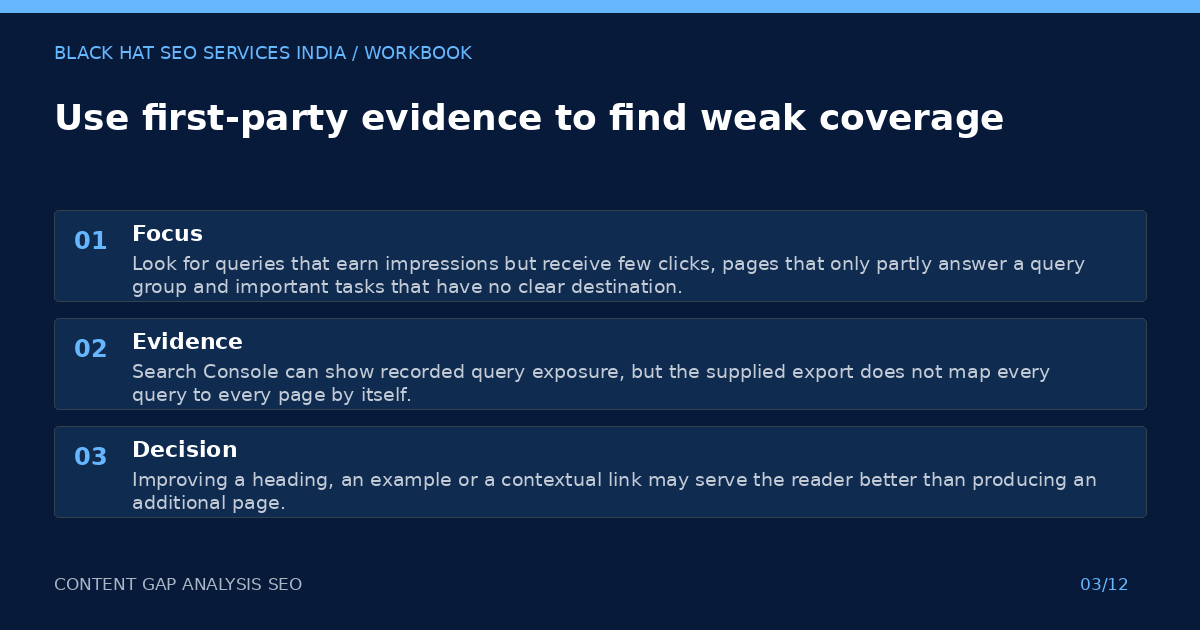
Look for queries that earn impressions but receive few clicks, pages that only partly answer a query group and important tasks that have no clear destination. Compare those findings with the visible results and customer questions. Search Console can show recorded query exposure, but the supplied export does not map every query to every page by itself. Validate query-to-page relationships through the appropriate filtered reports before declaring which page ranks for a specific term.
Add a simple inventory column for intent, evidence quality, freshness and next action. Distinguish missing content from unclear presentation. Sometimes the answer already exists but is buried below unrelated text or disconnected from navigation. Improving a heading, an example or a contextual link may serve the reader better than producing an additional page.
Choose improve, differentiate or create
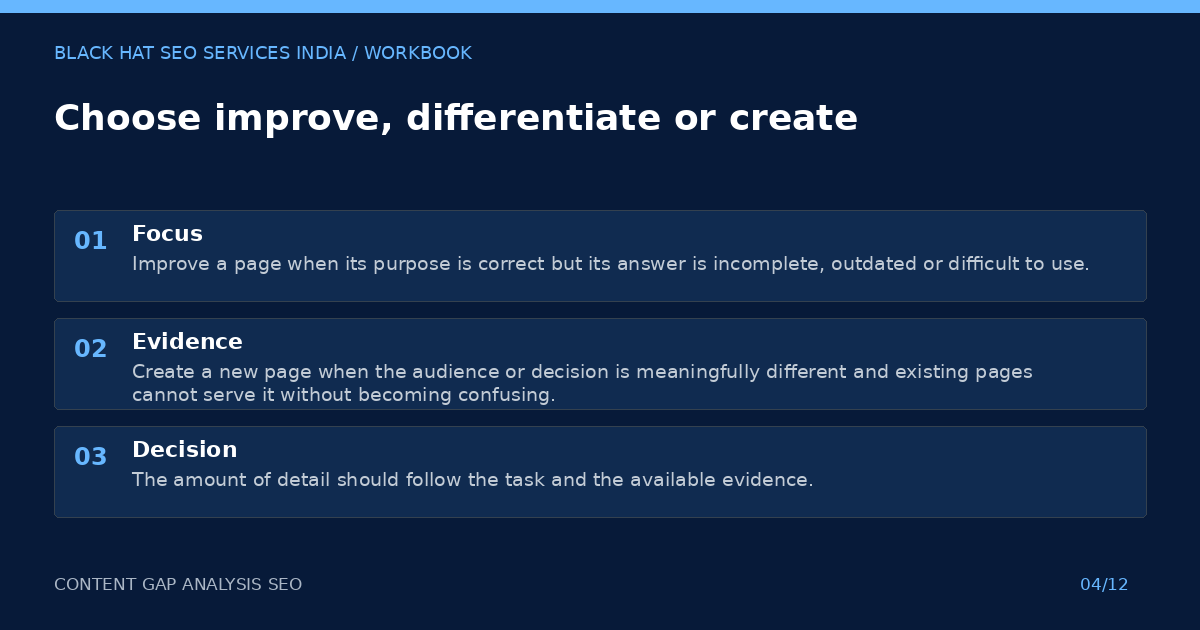
Improve a page when its purpose is correct but its answer is incomplete, outdated or difficult to use. Differentiate pages when they serve valuable but overlapping tasks. Create a new page when the audience or decision is meaningfully different and existing pages cannot serve it without becoming confusing. Preserve useful material and review incoming links before consolidating URLs. A content inventory should record why each decision was made.
Write a one-sentence scope for the target page and a short list of questions it must resolve. Include what makes the proposed answer distinctive: an original walkthrough, a decision table, a practical template or a clear explanation of trade-offs. Avoid treating competitor word count as a content requirement. The amount of detail should follow the task and the available evidence.
Build a reviewable editorial brief
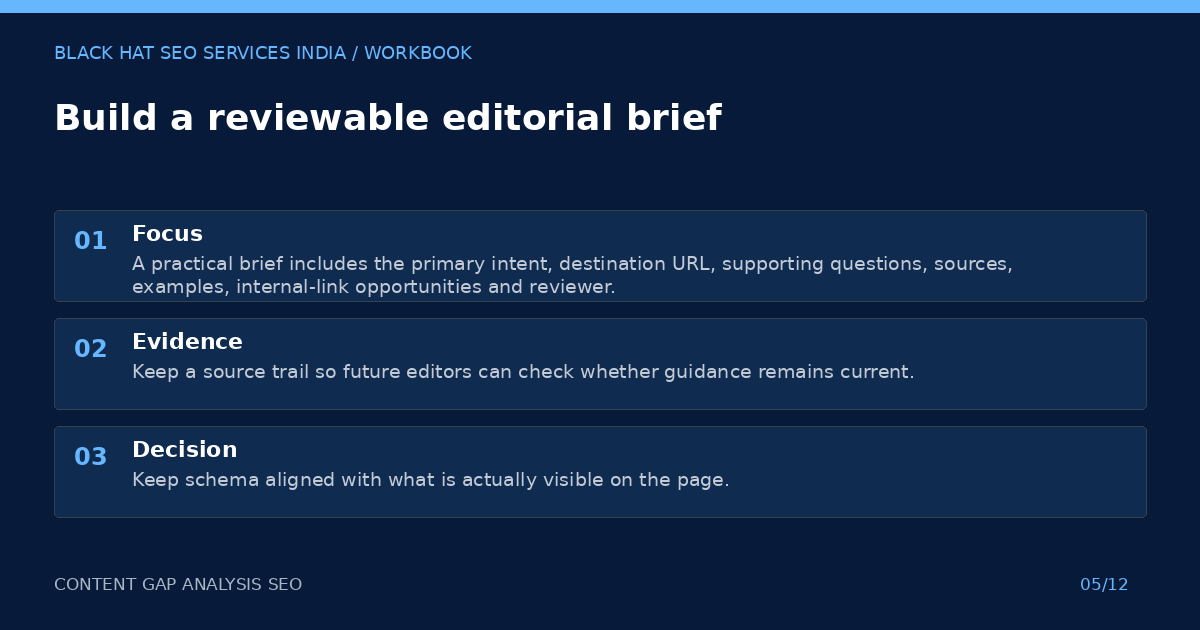
A practical brief includes the primary intent, destination URL, supporting questions, sources, examples, internal-link opportunities and reviewer. State which claims need verification and which sections depend on information from the business. Keep a source trail so future editors can check whether guidance remains current. For sensitive topics, choose a reviewer with appropriate subject knowledge instead of relying on fluent prose as a quality signal.
Include acceptance criteria that can be checked by a person. The reader should understand the decision, the example should support the explanation and each link should lead to a relevant next step. Technical checks should confirm the canonical, index directives and accessibility of important text. Keep schema aligned with what is actually visible on the page.
Measure usefulness after the update
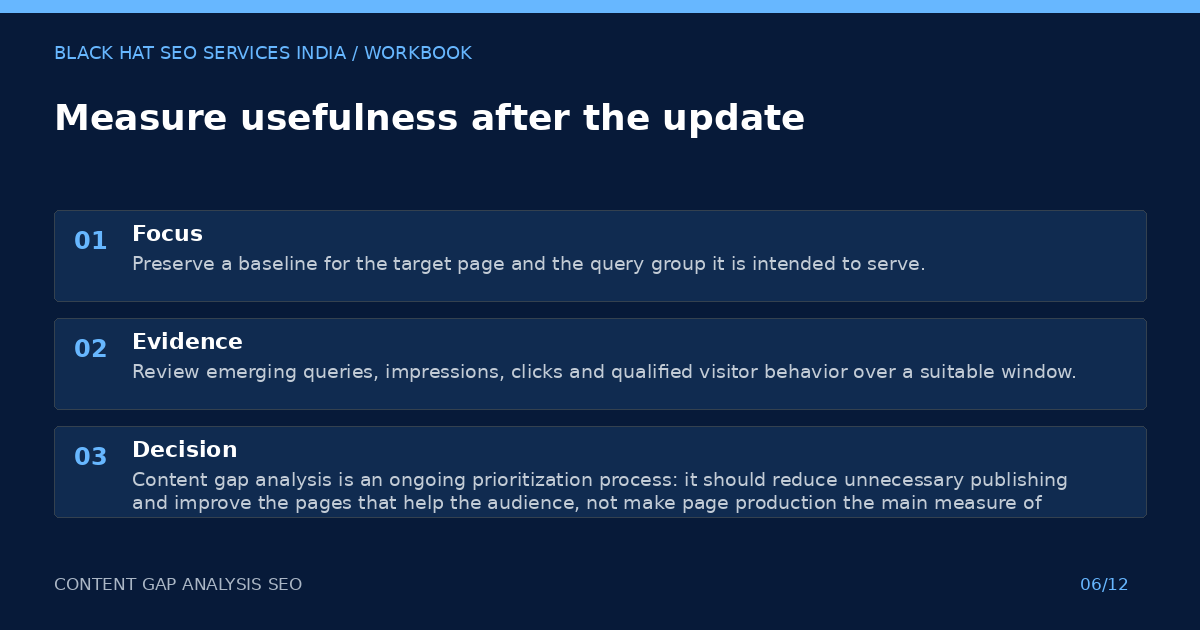
Preserve a baseline for the target page and the query group it is intended to serve. Record when the content changed and whether navigation or other templates changed at the same time. Review emerging queries, impressions, clicks and qualified visitor behavior over a suitable window. Low-volume pages may need more time to provide useful evidence, so avoid judging a change from a single day's movement.
A successful review can also reveal that the gap was less valuable than expected. Retain that finding and adjust the next brief. Content gap analysis is an ongoing prioritization process: it should reduce unnecessary publishing and improve the pages that help the audience, not make page production the main measure of progress.
Visual implementation workbook
Use these six distinct worksheets to plan the work and retain an audit trail. Add your own URLs, findings and owners alongside each stage.
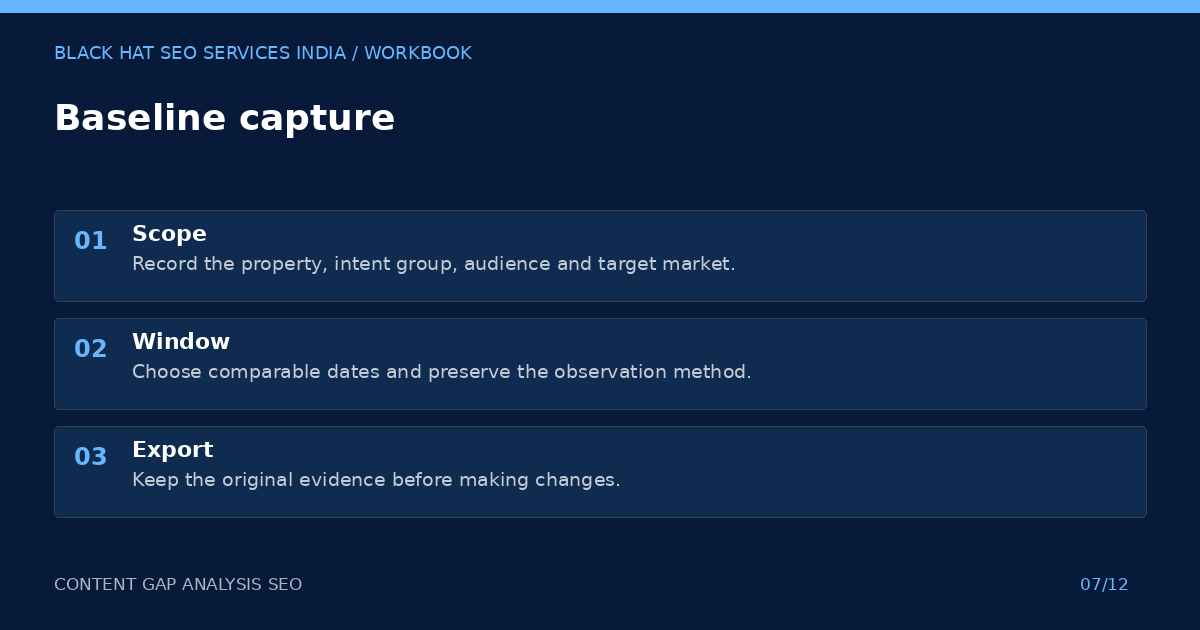
Scope: Record the property, intent group, audience and target market. Window: Choose comparable dates and preserve the observation method. Export: Keep the original evidence before making changes.
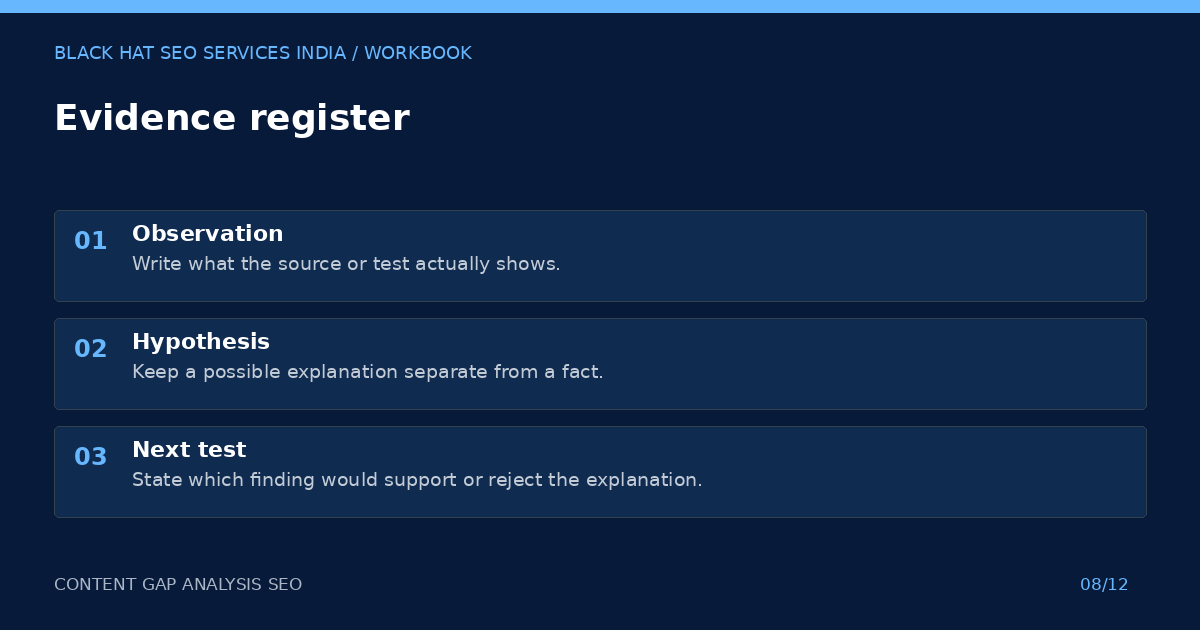
Observation: Write what the source or test actually shows. Hypothesis: Keep a possible explanation separate from a fact. Next test: State which finding would support or reject the explanation.
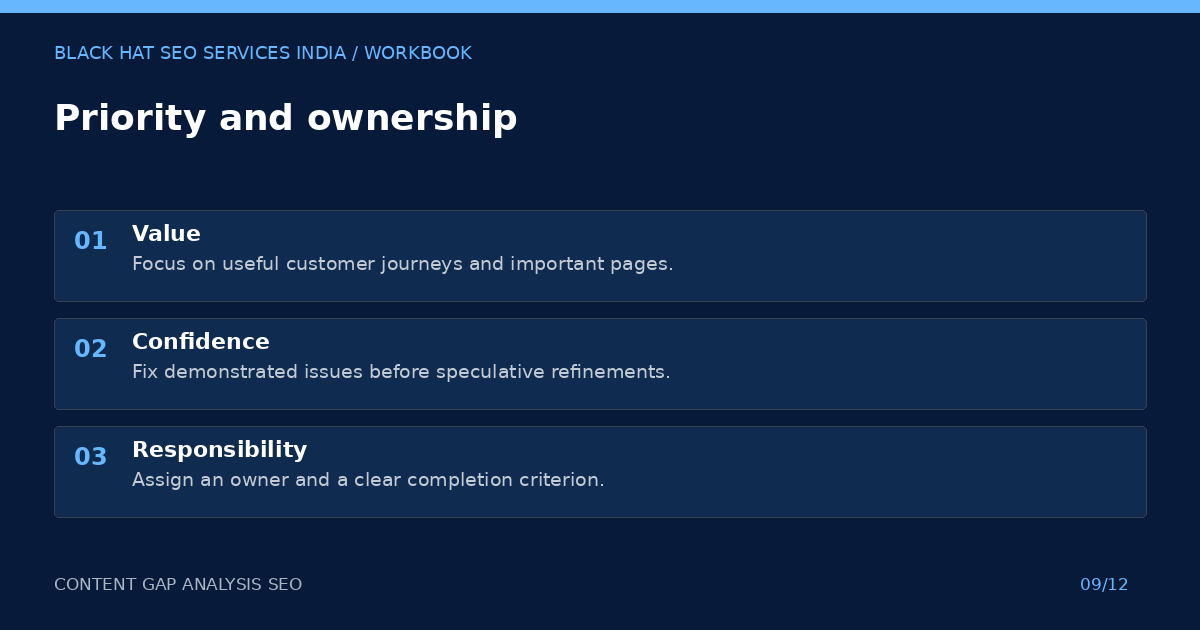
Value: Focus on useful customer journeys and important pages. Confidence: Fix demonstrated issues before speculative refinements. Responsibility: Assign an owner and a clear completion criterion.
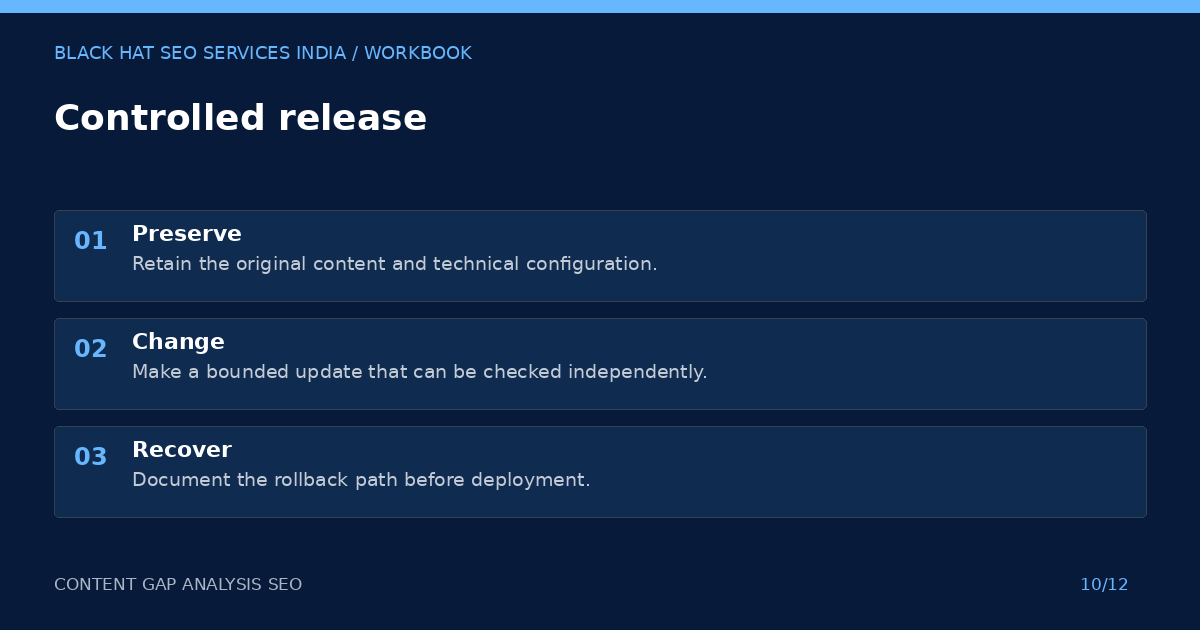
Preserve: Retain the original content and technical configuration. Change: Make a bounded update that can be checked independently. Recover: Document the rollback path before deployment.
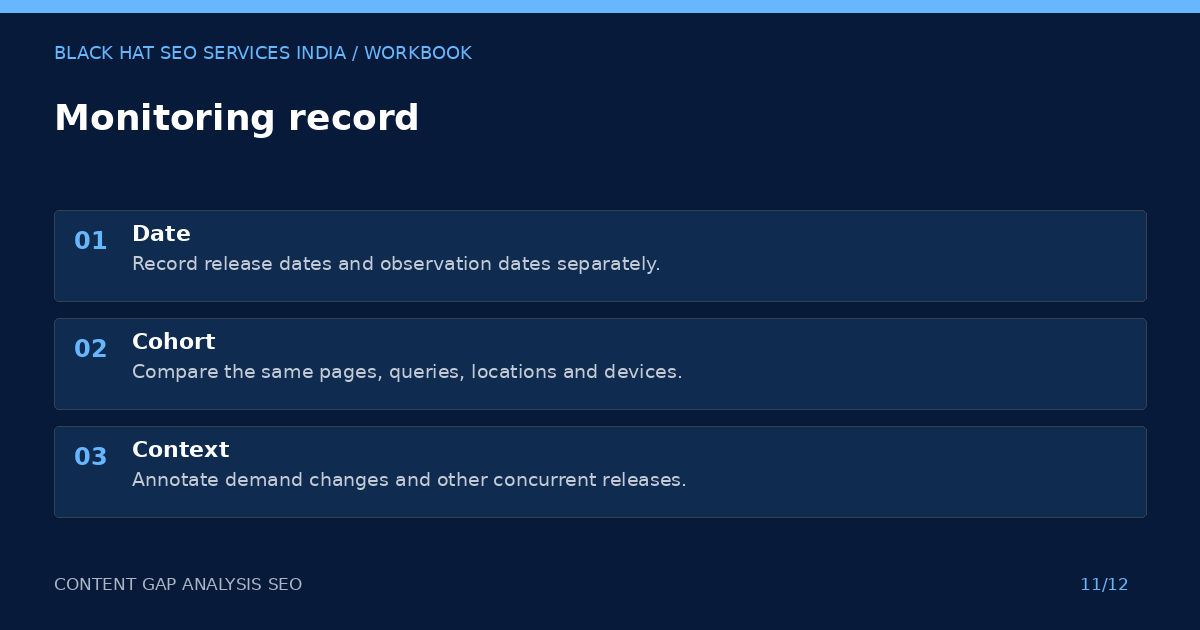
Date: Record release dates and observation dates separately. Cohort: Compare the same pages, queries, locations and devices. Context: Annotate demand changes and other concurrent releases.
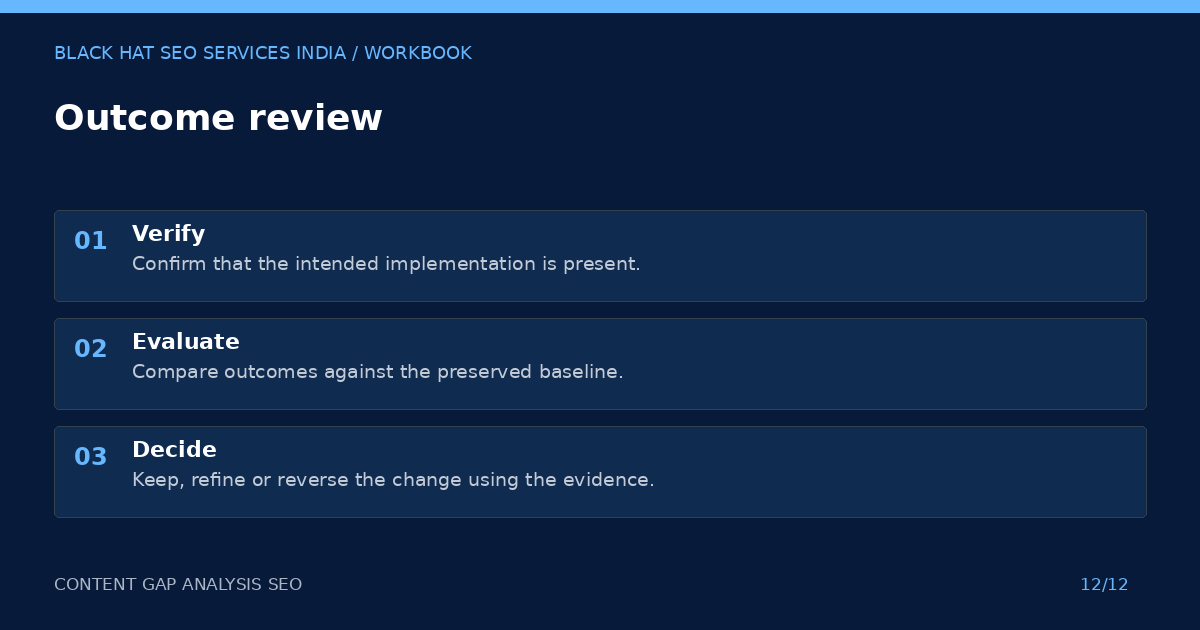
Verify: Confirm that the intended implementation is present. Evaluate: Compare outcomes against the preserved baseline. Decide: Keep, refine or reverse the change using the evidence.
Measurement and decision rules
| Signal | Interpretation | Next review |
|---|---|---|
| Impressions | Recorded exposure for the selected report scope | Compare the same query and page groups |
| Clicks | Recorded visits initiated from search results | Review result context and destination usefulness |
| CTR | Clicks divided by impressions | Inspect intent and result-layout changes |
| Average position | An aggregate across recorded impressions | Avoid treating a sitewide average as one fixed rank |
Search measurement glossary
- Impressions
- The number of times a result was shown in the selected Search Console report.
- Clicks
- The clicks recorded for results in the same Search Console report scope.
Frequently asked questions
What is the first step for content gap analysis seo?
Content gap analysis SEO is useful when a gap means a question your audience cannot currently answer using your website.
Should every keyword have a separate page?
No. Group variations that serve the same reader task. Create a new URL when the audience or purpose is meaningfully different.
Which evidence should I preserve?
Keep the original exports, observation dates, affected URLs, implementation log and review decision.
How do I judge an improvement?
Use a consistent baseline and page/query cohort, then distinguish completed implementation from observed search outcomes.
Does this guarantee a ranking position?
No. Use accountable work, accurate reporting and useful page content as the basis for decisions.
Download the companion PDF
Keep the complete guide, checklists and implementation workbook in a portable format.
Credits, sources and further review
Image credit and reuse
These twelve original instructional graphics were prepared for Black Hat SEO Services India. Credit: Black Hat SEO Services India — original guide artwork. For permission to reproduce or adapt a graphic, identify the image and contact the agency. No third-party stock photography is included.
Request image reuse permission
Official references
Need a search-growth plan for your website?
Share the domain, priority market and commercial goal. The first conversation can focus on where visibility is being lost, where demand exists and which changes deserve priority.