Black Hat SEO Services India: A Provider Review Checklist
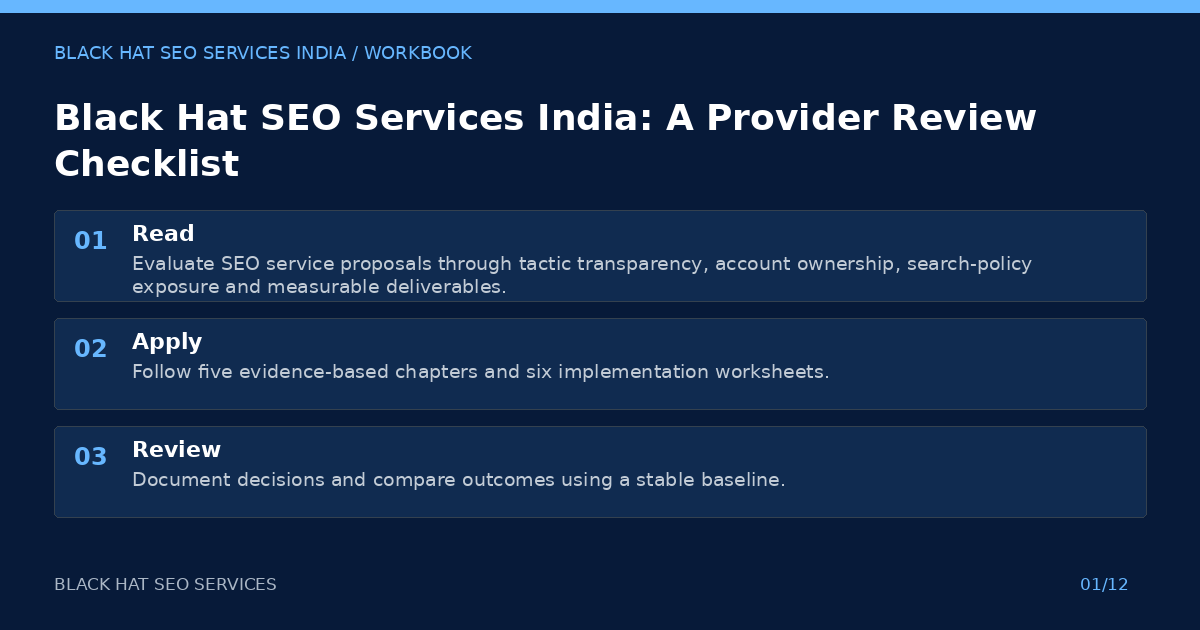
Evaluate SEO service proposals through tactic transparency, account ownership, search-policy exposure and measurable deliverables.
A practical starting point
Black hat SEO services is a search phrase used for a wide range of offers, including tactics intended to manipulate search rankings. Before evaluating a provider, ask what work will actually be performed: technical changes, content production, link placement, monitoring or account configuration. The label alone tells you little about the implementation. A proposal should name the affected properties, intended outputs and the evidence the client will receive.
In this guide
Table of contents
- A practical starting point
- Translate the label into actual deliverables
- Identify policy exposure and hidden dependencies
- Protect ownership and access
- Compare proposals with a practical scorecard
- Use a controlled improvement plan
- Visual implementation workbook
- Measurement and decision rules
- Continue your research
- Frequently asked questions
- Download the companion PDF
- Credits, sources and further review
- Need a search-growth plan for your website?
Translate the label into actual deliverables
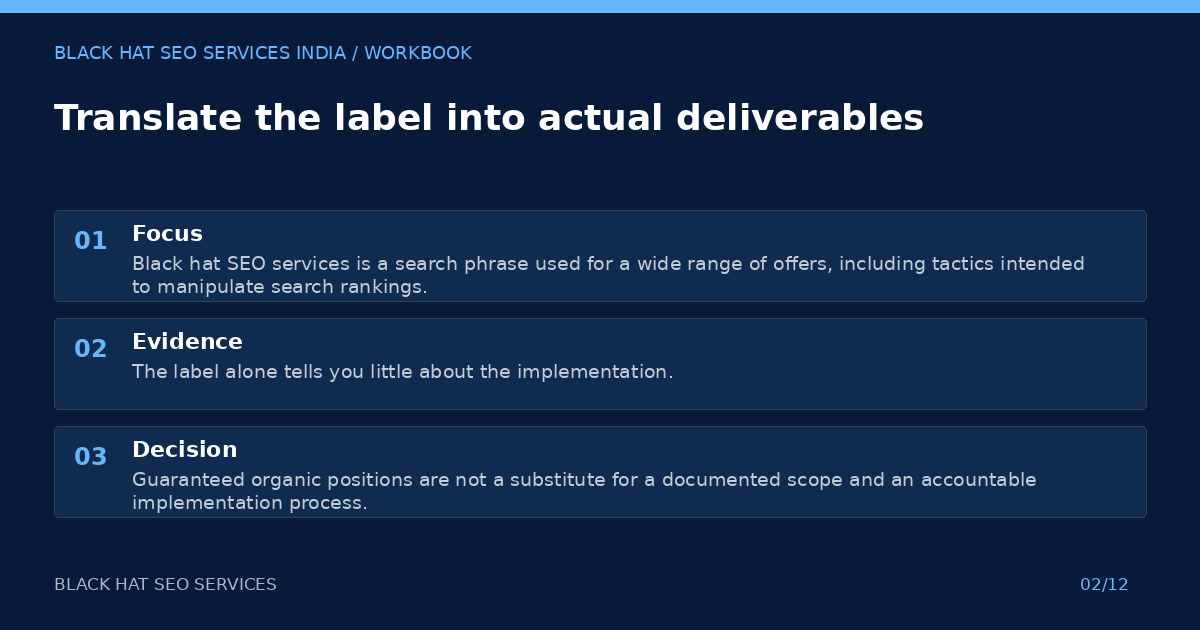
Black hat SEO services is a search phrase used for a wide range of offers, including tactics intended to manipulate search rankings. Before evaluating a provider, ask what work will actually be performed: technical changes, content production, link placement, monitoring or account configuration. The label alone tells you little about the implementation. A proposal should name the affected properties, intended outputs and the evidence the client will receive.
Distinguish studying risky tactics from authorizing their deployment. A useful evaluation can explain the operational and search-policy exposure without carrying out manipulation. Ask the provider to describe how each task helps users and how its output can be reviewed. Guaranteed organic positions are not a substitute for a documented scope and an accountable implementation process.
Identify policy exposure and hidden dependencies
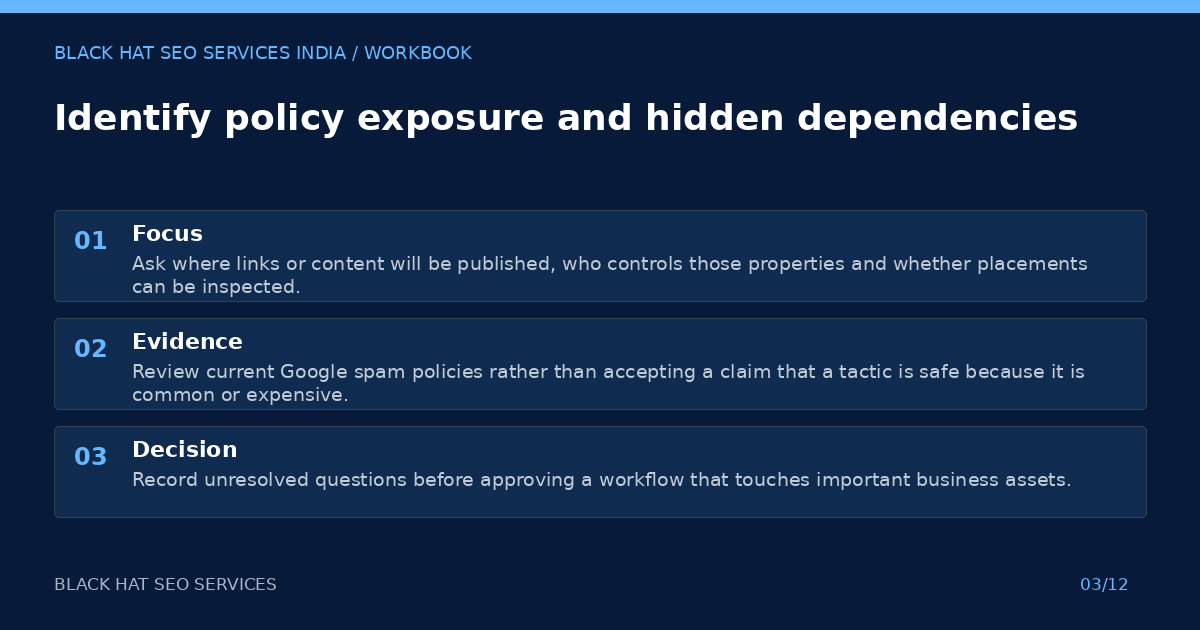
Ask where links or content will be published, who controls those properties and whether placements can be inspected. Link schemes, deceptive presentation and scaled low-value content can introduce search-policy problems. Review current Google spam policies rather than accepting a claim that a tactic is safe because it is common or expensive. Require the provider to state dependencies such as rented pages, private networks or accounts controlled solely by the vendor.
Avoid proposals that rely on fabricated reviews, hidden keyword text or misleading structured data. A clean syntax result does not make false content appropriate. The review should separate useful automation, such as detecting broken links, from automated publishing designed to manipulate visibility. Record unresolved questions before approving a workflow that touches important business assets.
Protect ownership and access
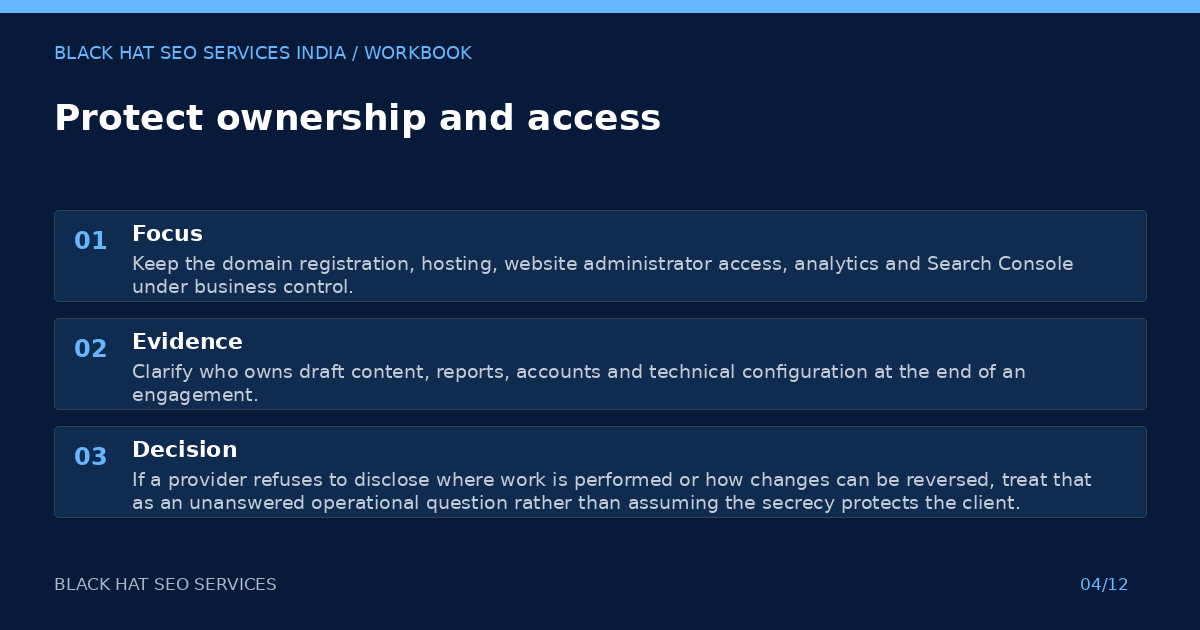
Keep the domain registration, hosting, website administrator access, analytics and Search Console under business control. Give providers only the access required for their agreed work and maintain a way to revoke it. Clarify who owns draft content, reports, accounts and technical configuration at the end of an engagement. A handover should leave enough information for another team to maintain the work.
Require an implementation log that identifies the change, the date and the responsible person. Preserve the original state before broad technical edits. If a provider refuses to disclose where work is performed or how changes can be reversed, treat that as an unanswered operational question rather than assuming the secrecy protects the client.
Compare proposals with a practical scorecard
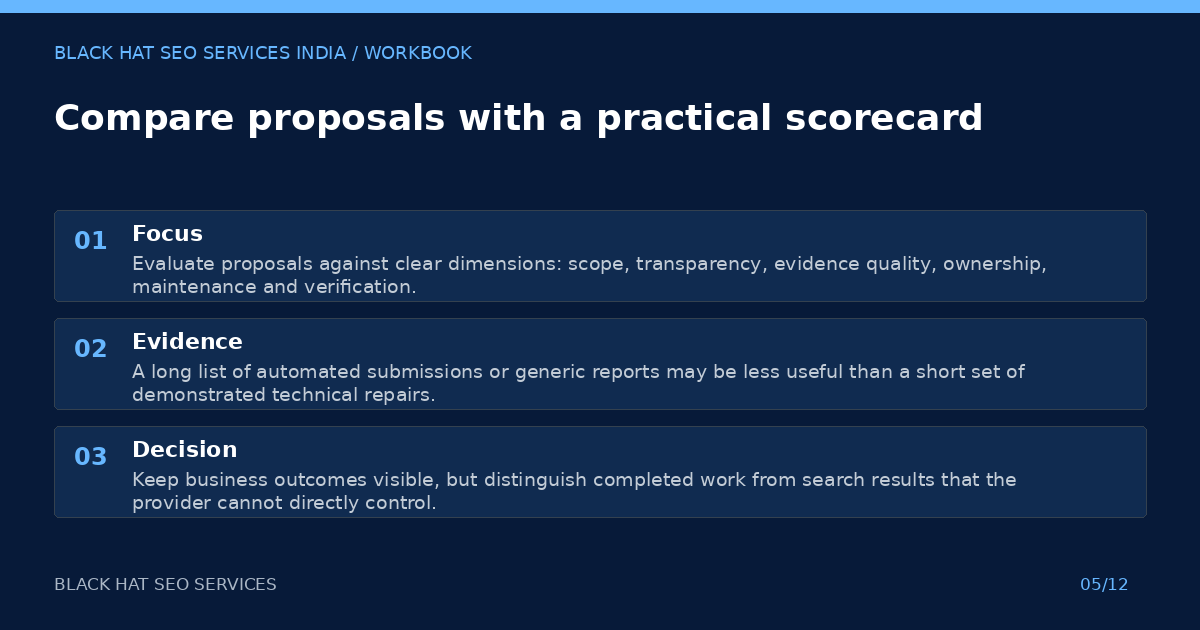
Evaluate proposals against clear dimensions: scope, transparency, evidence quality, ownership, maintenance and verification. Ask for a sample deliverable that shows how findings become tasks. A long list of automated submissions or generic reports may be less useful than a short set of demonstrated technical repairs. Compare like-for-like work and avoid assuming that activity counts measure the value delivered to readers or customers.
Agree on completion criteria before the work starts. For a technical task, the criterion might be a verified response or canonical correction on a defined set of URLs. For content, it might be an approved brief and a useful reviewed page. Keep business outcomes visible, but distinguish completed work from search results that the provider cannot directly control.
Use a controlled improvement plan
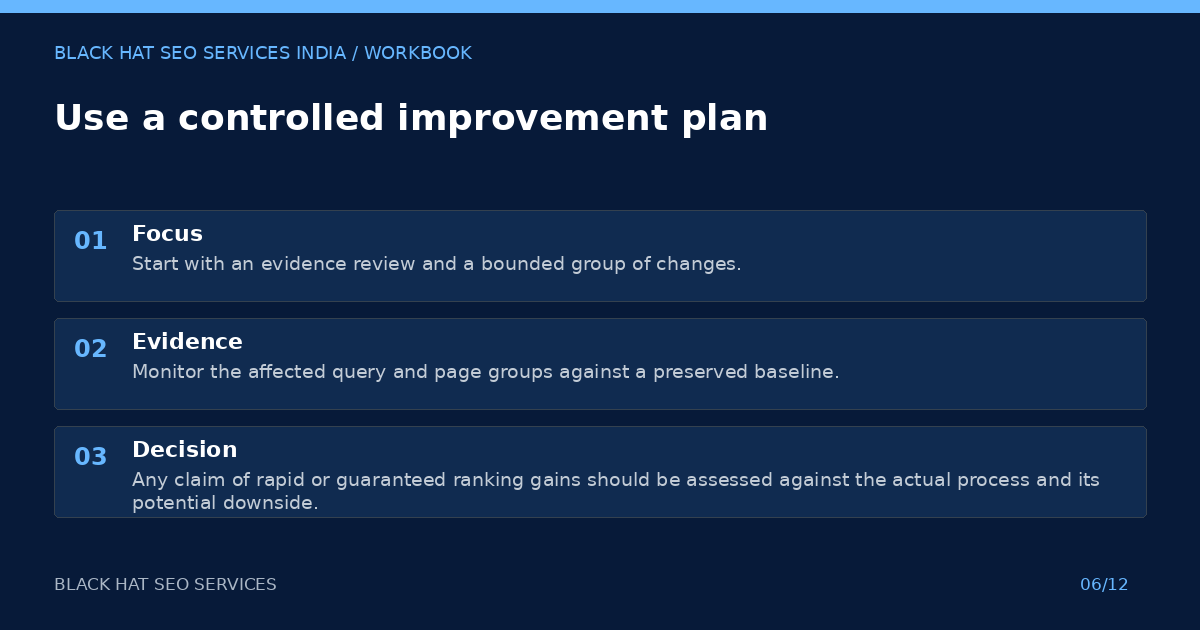
Start with an evidence review and a bounded group of changes. Resolve confirmed technical blockers, strengthen useful existing pages and improve relevant internal links before expanding production. Monitor the affected query and page groups against a preserved baseline. Avoid releasing many unrelated changes at once when the team needs to understand which hypothesis is working.
Review outcomes openly and retain unsuccessful findings. If the original approach lacks evidence, revise the plan rather than escalating to more opaque tactics. The strongest deliverable is a maintainable website, clear ownership and a measurement method the business understands. Any claim of rapid or guaranteed ranking gains should be assessed against the actual process and its potential downside.
Visual implementation workbook
Use these six distinct worksheets to plan the work and retain an audit trail. Add your own URLs, findings and owners alongside each stage.
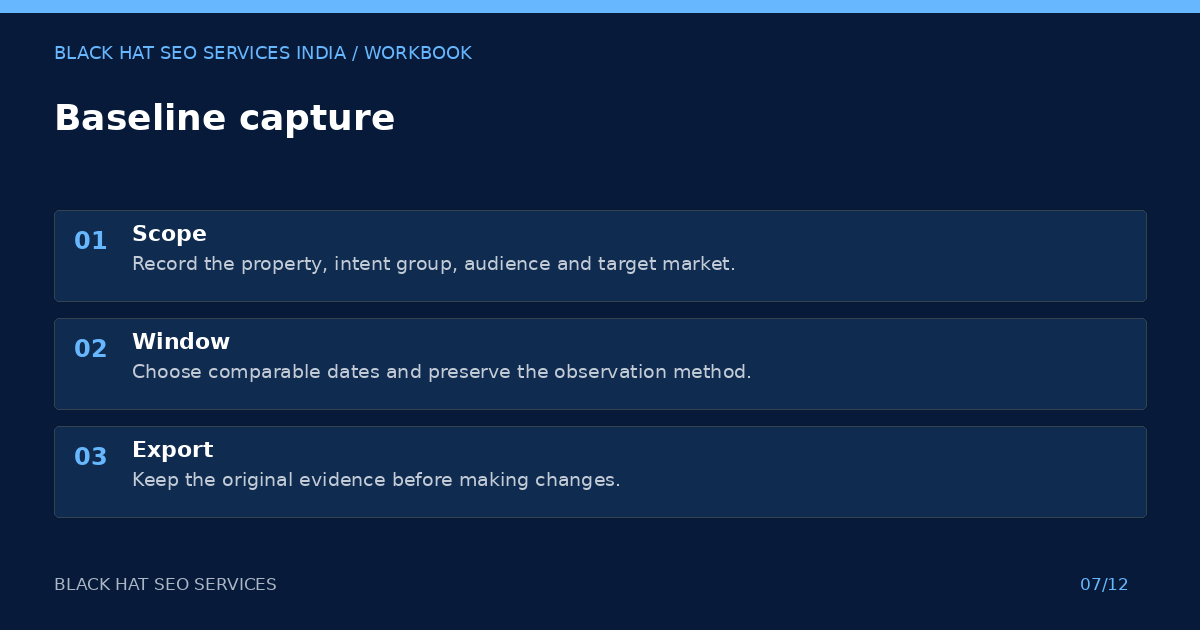
Scope: Record the property, intent group, audience and target market. Window: Choose comparable dates and preserve the observation method. Export: Keep the original evidence before making changes.
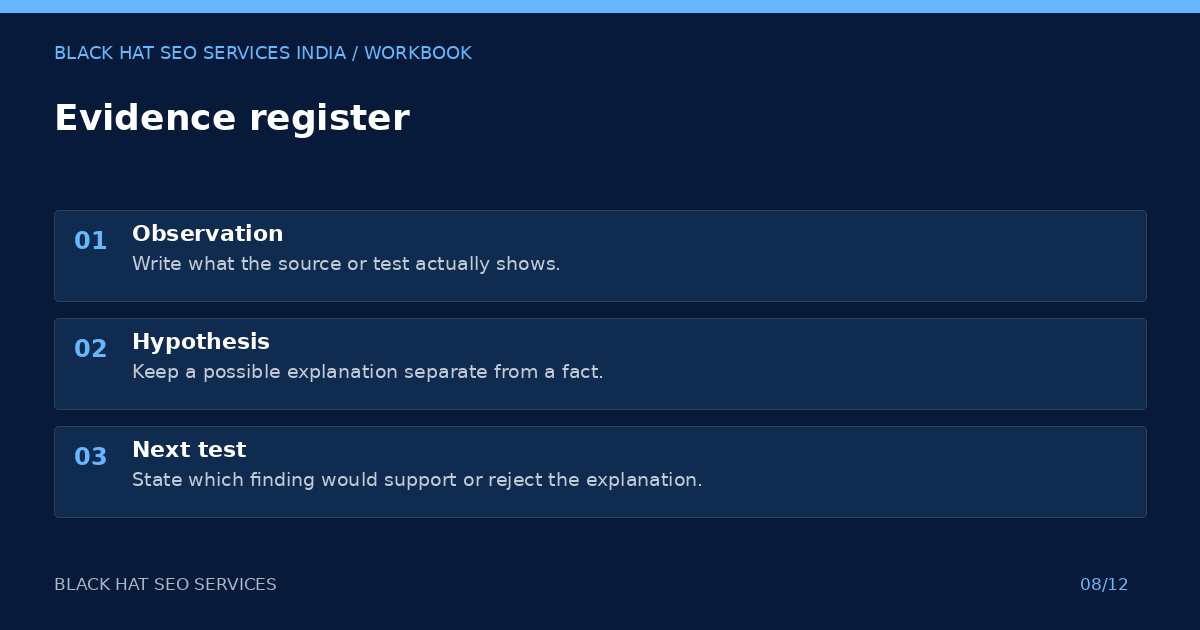
Observation: Write what the source or test actually shows. Hypothesis: Keep a possible explanation separate from a fact. Next test: State which finding would support or reject the explanation.
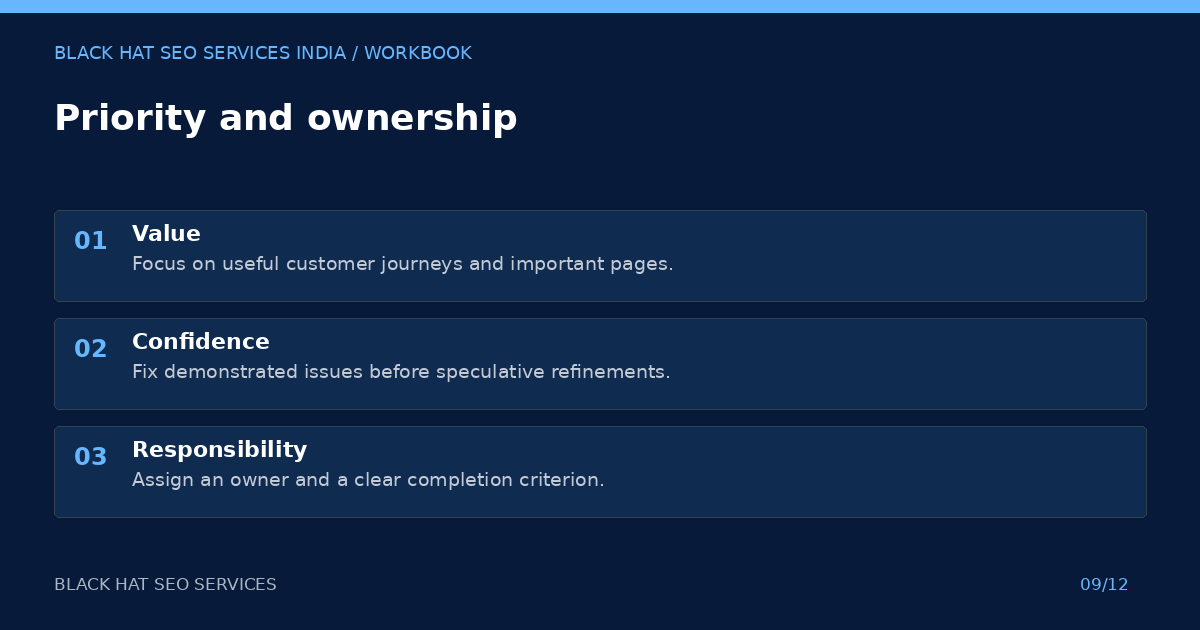
Value: Focus on useful customer journeys and important pages. Confidence: Fix demonstrated issues before speculative refinements. Responsibility: Assign an owner and a clear completion criterion.
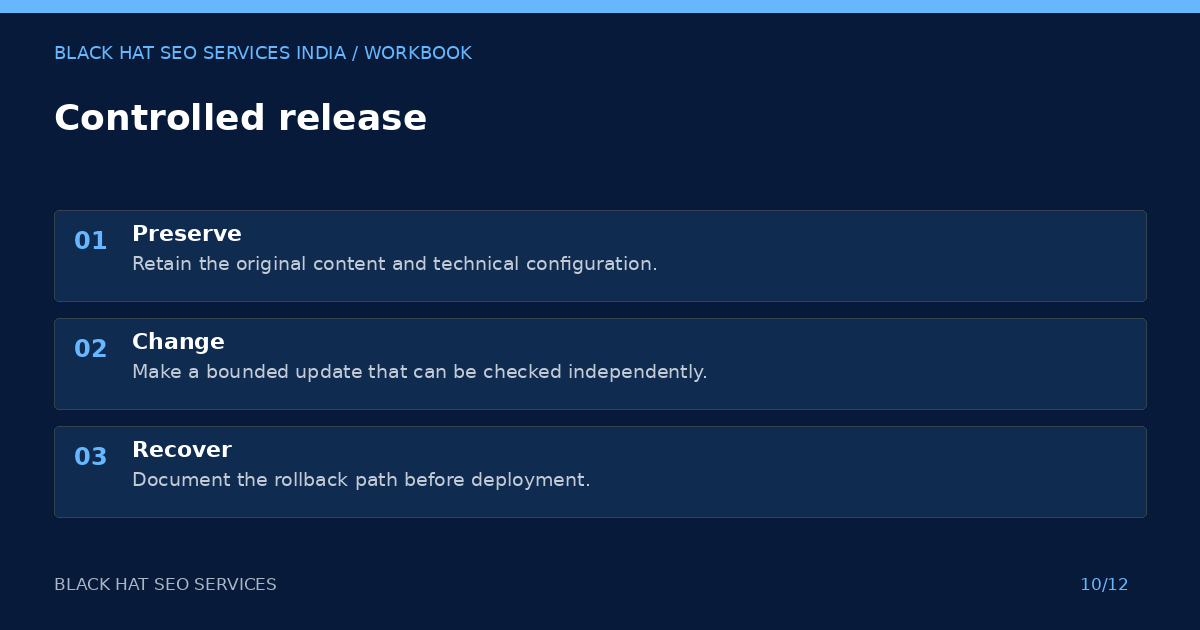
Preserve: Retain the original content and technical configuration. Change: Make a bounded update that can be checked independently. Recover: Document the rollback path before deployment.
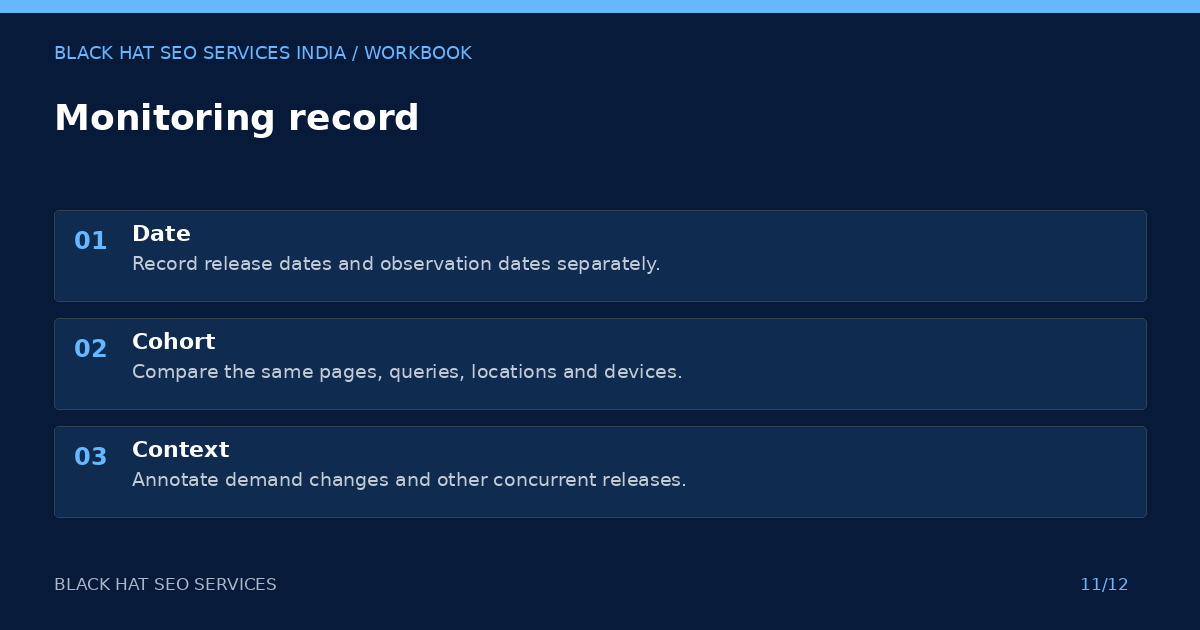
Date: Record release dates and observation dates separately. Cohort: Compare the same pages, queries, locations and devices. Context: Annotate demand changes and other concurrent releases.
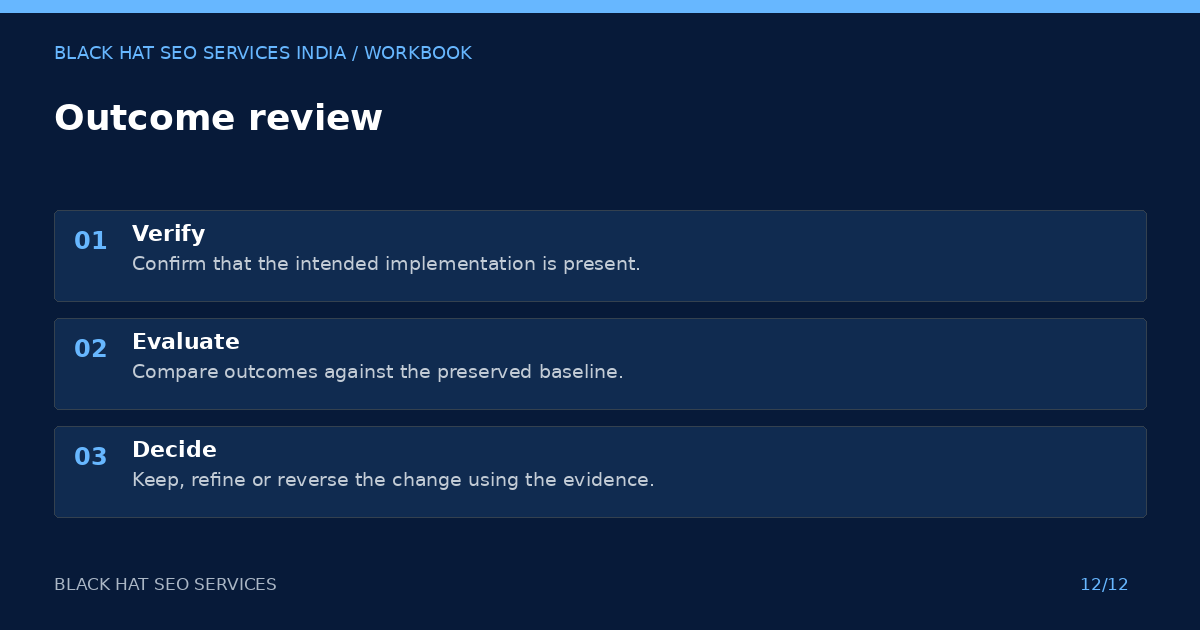
Verify: Confirm that the intended implementation is present. Evaluate: Compare outcomes against the preserved baseline. Decide: Keep, refine or reverse the change using the evidence.
Measurement and decision rules
| Signal | Interpretation | Next review |
|---|---|---|
| Impressions | Recorded exposure for the selected report scope | Compare the same query and page groups |
| Clicks | Recorded visits initiated from search results | Review result context and destination usefulness |
| CTR | Clicks divided by impressions | Inspect intent and result-layout changes |
| Average position | An aggregate across recorded impressions | Avoid treating a sitewide average as one fixed rank |
Search measurement glossary
- Impressions
- The number of times a result was shown in the selected Search Console report.
- Clicks
- The clicks recorded for results in the same Search Console report scope.
Frequently asked questions
What is the first step for black hat seo services?
Black hat SEO services is a search phrase used for a wide range of offers, including tactics intended to manipulate search rankings.
Should every keyword have a separate page?
No. Group variations that serve the same reader task. Create a new URL when the audience or purpose is meaningfully different.
Which evidence should I preserve?
Keep the original exports, observation dates, affected URLs, implementation log and review decision.
How do I judge an improvement?
Use a consistent baseline and page/query cohort, then distinguish completed implementation from observed search outcomes.
Does this guarantee a ranking position?
No. Use accountable work, accurate reporting and useful page content as the basis for decisions.
Download the companion PDF
Keep the complete guide, checklists and implementation workbook in a portable format.
Credits, sources and further review
Image credit and reuse
These twelve original instructional graphics were prepared for Black Hat SEO Services India. Credit: Black Hat SEO Services India — original guide artwork. For permission to reproduce or adapt a graphic, identify the image and contact the agency. No third-party stock photography is included.
Request image reuse permission
Official references
Need a search-growth plan for your website?
Share the domain, priority market and commercial goal. The first conversation can focus on where visibility is being lost, where demand exists and which changes deserve priority.