Printable guide: SEO Technical Analysis and Evaluation: From Crawl Findings to Verified Fixes
SEO technical analysis and evaluation turns website observations into a prioritized, testable repair plan.
Published 31 October 2026 · Updated 31 October 2026 · BlackHatSEOServices.in Editorial · 3,074 words · 14 min read
SEO Research and Practical Guidance
The practical starting point
SEO technical analysis and evaluation turns website observations into a prioritized, testable repair plan. A crawler can identify patterns, but it cannot decide the business importance of every URL or understand every publishing constraint. A useful audit combines representative page inspection, site architecture, measurement and implementation judgment. This guide explains how to scope the review, distinguish symptoms from causes and verify repairs without promising that a clean tool score guarantees rankings. It is intended for site owners, developers and search teams who need a shared method for deciding what to fix first.
SEO Research and Practical Guidance
Scope the audit around page types
List the important templates and customer journeys before running a crawl. A product catalogue, a service site and a publication expose different technical patterns. Include representative high-value and problematic URLs, plus known migrations or platform constraints. Define what the audit can access and what it cannot. This keeps the report from presenting a partial sample as a complete map of the website.
Related resource: Seo Technical Analysis And Evaluation.
Evidence to retain
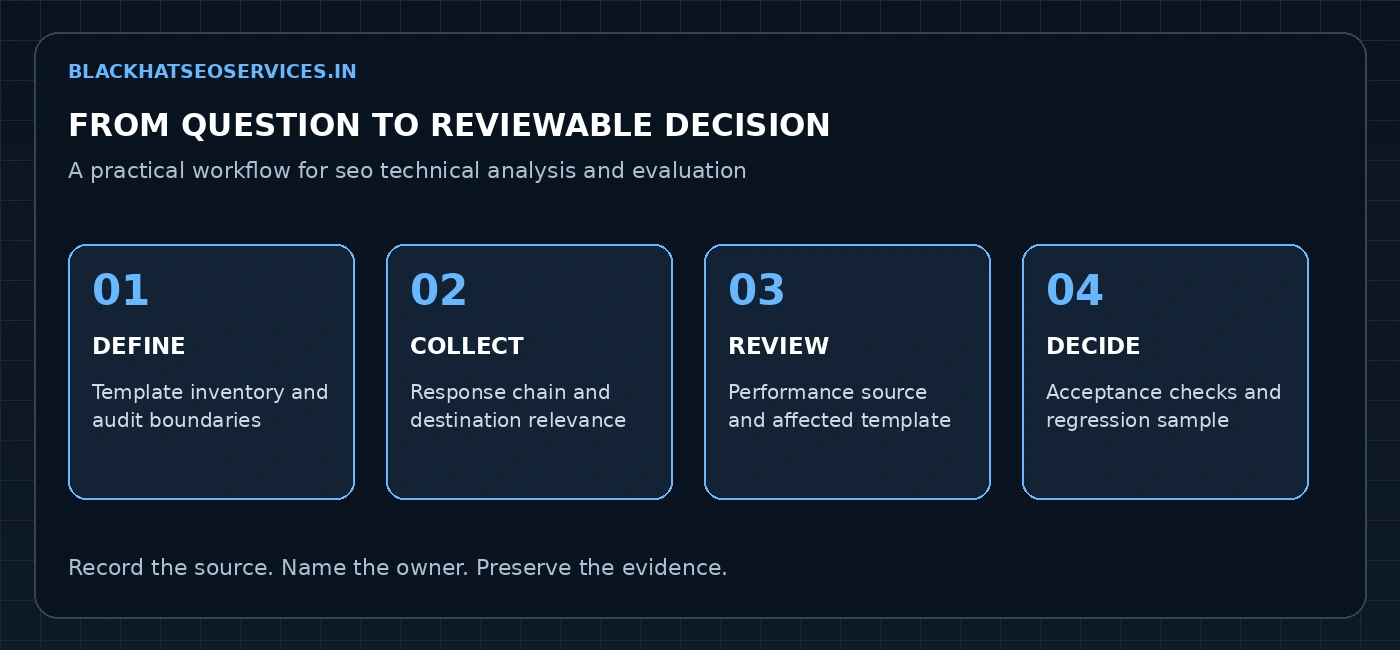
Template inventory and audit boundaries. Record who supplied the information and what it directly demonstrates. Keep your interpretation separate from the original material. If the source is incomplete, mark the item for follow-up rather than silently treating the missing detail as a favorable answer.
Choose representative URLs for each important page type.
SEO Research and Practical Guidance
Reconcile URL sources
Compare the crawl with sitemaps, known navigation and available search-performance exports. Each source can reveal URLs missing from another. Normalize obvious variants for analysis while preserving the original records. Investigate unexpected hosts, parameters and duplicate routes before treating every row as a separate page. A useful inventory distinguishes canonical content, alternate versions and intentionally retired material.
Related resource: Enterprise Technical Seo Audit.
Evidence to retain
URL inventory and source membership. Review a representative example before expanding the work. The example should match the actual task and preserve enough context for a second person to inspect it. A summary is useful only when the underlying observation remains available and understandable.
Identify URLs present in the sitemap but absent from the linked crawl.
SEO Research and Practical Guidance
Inspect status and redirect behavior
Open representative response chains and confirm the final destination. A redirect can be appropriate, but unnecessary chains and irrelevant destinations create maintenance problems. Evaluate broken URLs according to their importance and known references rather than fixing random rows first. For an intentionally removed resource, the correct answer may differ from restoring a page. Record the reasoning with the proposed treatment.
Related resource: Ecommerce Technical Seo Services.
Evidence to retain
Response chain and destination relevance. Name the person responsible for checking this item and record the review date. If the answer depends on a version, location or commercial arrangement, retain that condition. A finding that is true in one context may require a different decision elsewhere.
Test one affected URL from its original entry point to the final page.
SEO Research and Practical Guidance
Review indexing signals together
Check canonical references, robots directives, sitemap inclusion and visible content as a connected set. A directive that is sensible in one context can conflict with another setting. Avoid assuming that a successful HTTP response means a page should be indexed. Establish the intended state, compare it with the implementation and investigate disagreements. The report should explain the conflict rather than merely repeat tool labels.
Related resource: Technical Seo Consulting Services.
Evidence to retain
Intended index state and observed signals. Keep an unresolved-questions field beside the decision. This prevents a provisional interpretation from becoming an assumed fact during handover. Identify the smallest additional observation that would resolve the uncertainty before authorizing a larger commitment.
Write the intended treatment for each representative template before recommending changes.
Practical Review Workflow
SEO Research and Practical Guidance
Verify rendered content and navigation
Inspect whether the main answer and important links are available in the experience users receive. Interactive components should not hide essential information behind fragile behavior. Test mobile layouts, menus, tables and forms. A page can look attractive on a wide screen while making a key action difficult on a phone. Tie each finding to a specific user or discovery obstacle so developers understand its purpose.
Related resource: Competitive Seo Analysis Evidence Priority Framework.
Evidence to retain
Rendered page evidence and journey test. Check the proposed next action against the original reader or business need. An easy task is not necessarily a useful one. Explain the expected benefit in plain language so a reviewer can judge its relevance without relying on a tool score.
Complete a key task on a narrow screen and record any blocked step.
SEO Research and Practical Guidance
Evaluate performance with context
Separate laboratory diagnostics from observations collected from real users where available. Identify the templates and resources involved rather than treating a single homepage score as the whole site. Large media, excessive scripts and unstable layouts need different fixes. Agree on a realistic verification method with the development team. A meaningful performance task names the affected experience and expected improvement, not just a target score.
Related resource: Competitive Seo Analysis.
Evidence to retain
Performance source and affected template. Preserve one example of a limitation as well as a successful observation. This makes the review more balanced and helps future users recognize where the process stops being reliable. Explain how that limitation affects the decision rather than hiding it in a general footnote.
Trace one slow or unstable experience to a specific resource or layout behavior.
SEO Research and Practical Guidance
Prioritize root causes and dependencies
Group repeated findings by the underlying template or configuration. Fixing one shared component can be more valuable than editing many pages individually. Estimate impact, confidence, effort and release dependencies. Check whether a proposed repair changes other routes or publishing workflows. The priority list should help developers schedule work and help business owners understand why some visually small issues matter.
Related resource: Content Gap Analysis Seo Existing Page Improvement.
Evidence to retain
Root cause, impact and dependency. Agree on the completion check before the work starts. The check should establish the intended behavior using evidence available to the reviewer. If the result is different from the plan, record the difference and decide whether the action needs revision.
Turn a repeated error pattern into one owned implementation task.
SEO Research and Practical Guidance
Verify repairs after release
Define the expected result before implementation, then test representative affected and unaffected pages. Recheck response behavior, rendered content and relevant measurement. Preserve a change log and note unresolved limitations. A crawler showing fewer warnings is supporting evidence, not the only acceptance criterion. Confirm that the repair solved the original problem and did not create a new obstacle in a neighboring workflow.
Related resource: Content Gap Analysis Seo.
Evidence to retain
Acceptance checks and regression sample. Make the handover useful to the next person. Include the source, reasoning, decision and any maintenance trigger. A concise record with clear ownership is easier to continue than an unexplained collection of screenshots, links or exported rows.
Verify one corrected page and one related page expected to remain unaffected.
SEO Research and Practical Guidance
Worked scenario: applying the review
Illustrative example. This is a planning exercise, not a reported client result.
Imagine a technical audit returning thousands of warnings across a service website. The analyst groups URLs by template and compares the crawl with sitemap entries and known customer journeys. A repeated issue is traced to one shared component, while several alarming-looking rows turn out to be intentionally retired resources. The team records those distinctions before generating implementation tickets. This prevents warning volume from determining priority by itself.
The first repair ticket states the intended behavior, representative affected pages, dependencies and acceptance checks. The developer implements the change in a reviewable release. Verification includes an affected page, a related unaffected page and the customer action that originally exposed the issue. The team does not declare success solely because the crawler's warning count decreases.
The handover connects the finding, code or configuration change and verification evidence. Later search observations are reviewed with the release log, but the report distinguishes verified technical improvement from uncertain performance effects. A smaller backlog of well-explained root causes is more useful than thousands of unowned warnings. The pilot establishes a repeatable finding-to-fix process that can be extended to other templates without restarting the reasoning each time.
SEO Research and Practical Guidance
Build the working evidence file
Build the working brief around a website team translating technical findings into repair work. The required inputs are template samples, URL sources, response observations, rendering checks and release constraints. Confirm their owners and definitions before allocating implementation work. The planned handover is a prioritized technical backlog with acceptance and regression checks, which connects analysis to an operational decision. Every recommendation needs a relevant example, a proposed action and an acceptance check. This allows a business stakeholder and a delivery specialist to review the same finding without relying on an unexplained score or a long list of tool warnings.
Use a simple record with an item identifier, the original source, the observation, the interpretation, the proposed action and the reviewer. For example, the first record in this guide concerns template inventory and audit boundaries. Preserve the original evidence alongside the summary, because summaries can accidentally omit an important condition. Record missing information explicitly. An empty cell should mean the item has not yet been reviewed, while a completed review with insufficient evidence should have a written reason. Those are different states and should not be confused in a progress report.
Keep the file proportionate to the assignment. A small review may need only a few carefully documented rows. Adding hundreds of incomplete entries can make the work harder to prioritize. Ask the technical analyst and the developer responsible for release to agree on the first decision the file must support, then collect only the information needed for that decision. Protect confidential material and use anonymized examples when the reasoning does not depend on identity. The aim is a reusable record that supports scrutiny, rather than a large archive nobody can interpret.
SEO Research and Practical Guidance
Plan a bounded pilot before committing
The suggested pilot is to audit one template and deliver one complete finding-to-fix cycle. State the starting condition and the expected output before beginning. Keep its scope small enough that you can inspect every important result. Do not use a favorable first observation as permission to expand into unrelated work. A pilot answers a defined question about usefulness, delivery or interpretation; it is not a miniature promise that the same outcome will hold at any scale. Record what the exercise deliberately leaves untested.
Set practical acceptance criteria. The output should address the reader or business task, expose supporting evidence and explain unresolved limitations. Assign the review to the technical analyst and the developer responsible for release. Agree how defects or unanswered questions will be handled and who can authorize a revised scope. A review date is a checkpoint, not an instruction to invent certainty when the evidence is incomplete. If an essential input is unavailable, the correct result may be to pause the decision and obtain it, rather than proceed on a convenient assumption.
Use a stop condition as well as a success condition. In this case, a reason to stop or investigate is that a proposed repair has no stated intended behavior or verification method. Document that condition before the work begins so sunk effort does not become the reason to continue. Preserve useful partial findings, explain what would need to change and identify a smaller alternative if appropriate. This makes a declined opportunity or an inconclusive pilot a reviewable outcome. The process has value when it prevents an unjustified commitment as well as when it supports a sensible next step.
SEO Research and Practical Guidance
Measure effort, outcomes and uncertainty
The primary operating measures are verified issue resolution, successful customer tasks and affected page-group observations. Define the units, source and review period for each before comparing results. Keep completed work separate from observed performance. A deliverable can be verified directly, while an outcome may depend on demand, timing, other releases or actions outside the team's control. This distinction makes reporting more honest and useful: the reader can see both whether the team fulfilled the brief and what the available observations suggest about its wider value.
Consider this illustrative planning example: a template fix affecting 500 useful pages may deserve attention before a cosmetic warning on one rarely used archive. These figures describe a method of comparison, not an audited result or forecast. Replace them with actual records before using them to justify expenditure. Include staff time, review, cleanup and maintenance in the comparison. A low purchase price can conceal a substantial operating burden, while a more focused option may deliver a useful result with less recurring work. Write down the assumptions that would change the decision so the calculation can be revisited without reconstructing the whole discussion.
Review the quality of the evidence rather than only the direction of a chart. Check whether definitions stayed consistent, whether the sample represents the task and whether another event offers a plausible explanation. For seo technical analysis and evaluation, the evaluation should remain tied to the specific observations documented in this guide. If counts are small or access is limited, narrow the conclusion accordingly. Record what additional evidence would strengthen or overturn it. A careful uncertainty note tells the next reviewer where to focus, instead of using vague caution to avoid making any practical recommendation.
SEO Research and Practical Guidance
Turn the review into a maintainable decision
The final record should state the chosen action, why it fits the evidence and what remains unresolved. Deliver a prioritized technical backlog with acceptance and regression checks with its original inputs, dated observations and next review trigger. Identify the person responsible for maintaining the record. A decision that depends on a product version, publishing arrangement, institutional fact or website configuration can become stale when that dependency changes. The handover should make those dependencies visible, so a later reviewer knows what needs rechecking rather than assuming the original conclusion remains permanently valid.
Translate the review into a small set of owned tasks. Each task needs a specific output, a responsible person, necessary inputs and an acceptance check. Use the actions in the eight sections above as starting points rather than generic instructions to improve SEO. For example, revisit the evidence for acceptance checks and regression sample before expanding the work. If two tasks depend on the same unresolved question, resolve it once and share the result. This reduces repeated research and avoids different team members making contradictory assumptions about the same issue.
After implementation or procurement, verify the intended behavior and capture any differences from the plan. Review verified issue resolution, successful customer tasks and affected page-group observations at the agreed checkpoint and explain what the comparison can support. Keep useful unsuccessful findings, because they show which assumptions were tested and which approach should not be repeated without new evidence. A future update should improve the substance of the record, not merely refresh its visible date. The durable outcome is a clear, accountable process that another person can understand and continue when the original reviewer is no longer available.
SEO Research and Practical Guidance
Your printable review checklist
| Step | Evidence | Next action |
|---|---|---|
| 01 | Template inventory and audit boundaries | Choose representative URLs for each important page type. |
| 02 | URL inventory and source membership | Identify URLs present in the sitemap but absent from the linked crawl. |
| 03 | Response chain and destination relevance | Test one affected URL from its original entry point to the final page. |
| 04 | Intended index state and observed signals | Write the intended treatment for each representative template before recommending changes. |
| 05 | Rendered page evidence and journey test | Complete a key task on a narrow screen and record any blocked step. |
| 06 | Performance source and affected template | Trace one slow or unstable experience to a specific resource or layout behavior. |
| 07 | Root cause, impact and dependency | Turn a repeated error pattern into one owned implementation task. |
| 08 | Acceptance checks and regression sample | Verify one corrected page and one related page expected to remain unaffected. |
Keep the source and review date beside each completed row. Use the full PDF for an offline copy of this guide.
SEO Research and Practical Guidance
Frequently asked questions
What is technical SEO evaluation?
It is the interpretation of technical observations in the context of a website's intended behavior and business purpose. A useful evaluation produces owned repair tasks with evidence, priorities and acceptance checks rather than only exporting crawler warnings.
Is a crawl enough for a complete audit?
No. A crawl is one view of the site. Compare it with sitemaps, known URLs, representative rendering and relevant measurement. State the scope and access limits so readers understand what the audit may have missed.
How should technical issues be prioritized?
Consider affected useful pages, user impact, confidence in the diagnosis, implementation effort and dependencies. Group repeated findings by root cause. A clear rationale is more useful than treating every tool severity label as a fixed business priority.
Should every broken URL be restored?
No. Determine its purpose, references and intended lifecycle. Some resources are legitimately retired. Choose a treatment that serves users and reflects the site's information structure rather than redirecting every removed page to an unrelated destination.
What should canonical review include?
Compare the intended canonical with redirects, indexing directives, sitemap membership and actual content. Assess signals together. A canonical field viewed in isolation cannot explain every duplicate or indexing situation.
Why test rendered content?
Users and discovery systems need the important information and links to be available reliably. Fragile interactive behavior can conceal essential content or navigation. Inspect representative pages and key tasks rather than assuming the source template always produces a usable result.
Are performance scores direct business outcomes?
No. Scores and diagnostics help identify problems, but useful outcomes relate to the actual experience. Record the source and conditions, identify affected templates and verify the specific resource or layout improvement after implementation.
What belongs in a developer-ready ticket?
Include affected examples, intended behavior, observed evidence, likely root cause, scope, dependencies and acceptance checks. Explain why the issue matters. The developer should be able to implement and verify the task without reconstructing the entire audit.
How do I verify a repair?
Test the expected behavior on representative affected pages and inspect related pages for unintended effects. Use the relevant response, rendering or measurement checks. Retain the release date and evidence so later changes can be interpreted.
Does fixing technical errors guarantee rankings?
No. Technical work can remove obstacles and improve usability, but search outcomes depend on relevance, competition and other factors. Report verified repairs as delivery outcomes and interpret subsequent visibility changes with appropriate context.
SEO Research and Practical Guidance
Further reference material
Use current official documentation when verifying search terminology, technical requirements or platform policies.
SEO Research and Practical Guidance
Get the complete printable guide
Save the full article, worked scenario, checklist and all 10 FAQ answers for offline review.