Competitive SEO Analysis: Turn Search Gaps into a Prioritized Plan
Competitive SEO analysis examines how other pages satisfy the searches your business wants to serve.
Published 31 October 2026 · Updated 31 October 2026 · BlackHatSEOServices.in Editorial · 3,080 words · 14 min read
SEO Research and Practical Guidance
The practical starting point
Competitive SEO analysis examines how other pages satisfy the searches your business wants to serve. The useful output is a prioritized decision about your own website, rather than a copied content calendar or a spreadsheet of competitor metrics. Search competitors may differ from the companies your sales team meets in the market: publishers, directories and community pages can compete for the same query. This guide shows how to select a comparable search set, inspect what makes its pages useful and turn observed gaps into practical work. The process is designed for teams that need to act on a limited budget.
SEO Research and Practical Guidance
Select search competitors by customer task
Begin with the questions and service decisions your customers actually face. Observe which page types appear for those tasks and group them by intent. A national directory and a local specialist may both compete for visibility while serving different roles. Avoid assuming that your largest business rival is the correct benchmark for every query. Record why each comparison belongs in the analysis.
Related resource: Competitive Seo Analysis Evidence Priority Framework.
Evidence to retain
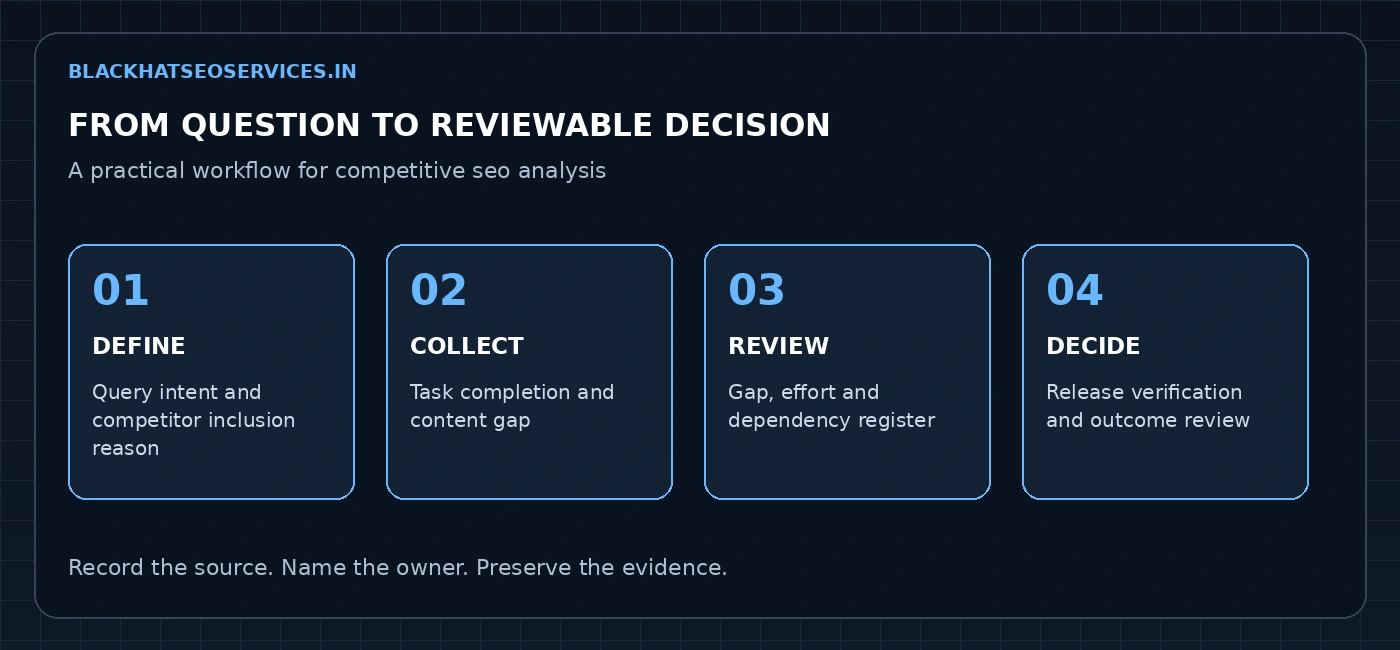
Query intent and competitor inclusion reason. Record who supplied the information and what it directly demonstrates. Keep your interpretation separate from the original material. If the source is incomplete, mark the item for follow-up rather than silently treating the missing detail as a favorable answer.
Choose a small set of searches and label the role of each competing result.
SEO Research and Practical Guidance
Compare pages rather than entire domains
Domain-level metrics can hide very different page quality. Open the exact result, identify its purpose and inspect the answer it provides. Note structure, evidence, tools, navigation and next steps. A competitor may rank with a useful calculator even though its overall site is smaller. The relevant comparison is between resources serving the same user need, not between logos on a market-position slide.
Related resource: Competitive Seo Analysis.
Evidence to retain
Comparable URLs and reader task. Review a representative example before expanding the work. The example should match the actual task and preserve enough context for a second person to inspect it. A summary is useful only when the underlying observation remains available and understandable.
Write the primary question each compared page answers.
SEO Research and Practical Guidance
Audit what the reader can accomplish
Evaluate whether the page helps someone decide, calculate, compare or complete a task. Counted headings and word length are weak substitutes for that assessment. Look for missing assumptions, unclear examples and friction between the answer and the next action. Your opportunity may be a clearer explanation or a better tool rather than a longer article. Describe the improvement in terms of reader usefulness.
Related resource: Content Gap Analysis Seo Existing Page Improvement.
Evidence to retain
Task completion and content gap. Name the person responsible for checking this item and record the review date. If the answer depends on a version, location or commercial arrangement, retain that condition. A finding that is true in one context may require a different decision elsewhere.
Identify one decision a visitor cannot confidently make after reading the page.
SEO Research and Practical Guidance
Separate observed evidence from inferred causes
You can observe a page's content and links, but you cannot directly see every reason it performs in search. Avoid claiming that one visible feature caused its position. Record plausible mechanisms and the evidence needed to assess them. A competitor's success may involve brand recognition, distribution or historical factors outside the visible page. This distinction prevents copying superficial features while missing the real audience need.
Related resource: Content Gap Analysis Seo.
Evidence to retain
Observation and hypothesis columns. Keep an unresolved-questions field beside the decision. This prevents a provisional interpretation from becoming an assumed fact during handover. Identify the smallest additional observation that would resolve the uncertainty before authorizing a larger commitment.
Mark each finding as directly observed or inferred.
Practical Review Workflow
SEO Research and Practical Guidance
Review technical accessibility
Inspect whether the compared experience is usable on mobile, understandable without fragile interactions and easy to navigate. Compare your own relevant page under the same conditions. Technical opportunities should be tied to actual obstacles, such as an unreadable table or a broken next-step link. Do not turn every tool warning into a competitive disadvantage without checking its relevance to the visitor task.
Related resource: Seo Content Gap Analysis.
Evidence to retain
Representative technical checks. Check the proposed next action against the original reader or business need. An easy task is not necessarily a useful one. Explain the expected benefit in plain language so a reviewer can judge its relevance without relying on a tool score.
Complete the same customer journey on both pages and record friction.
SEO Research and Practical Guidance
Build a gap list with realistic effort
Turn each opportunity into an output, owner and estimated effort. A missing sentence and a new data product should not sit in the same list without scale. Record dependencies such as expert review, development or data licensing. Identify whether an existing page can be improved before proposing a new URL. This reduces duplicated intent and makes the content plan easier to maintain.
Related resource: Seo Competitor Analysis Services.
Evidence to retain
Gap, effort and dependency register. Preserve one example of a limitation as well as a successful observation. This makes the review more balanced and helps future users recognize where the process stops being reliable. Explain how that limitation affects the decision rather than hiding it in a general footnote.
Assign each gap to update, create, investigate or decline.
SEO Research and Practical Guidance
Prioritize impact and confidence
Score the importance of the customer task, the likely usefulness of the improvement and confidence in the diagnosis. Keep the scoring understandable and avoid false precision. A low-effort correction to a key service page may outrank a speculative new content cluster. Discuss trade-offs with the business owner so the plan reflects commercial constraints rather than only the analyst's preferred topics.
Related resource: Seo Competitor Keyword Analysis.
Evidence to retain
Priority rationale and business relevance. Agree on the completion check before the work starts. The check should establish the intended behavior using evidence available to the reviewer. If the result is different from the plan, record the difference and decide whether the action needs revision.
Explain why the top action deserves resources before the second action.
SEO Research and Practical Guidance
Measure your improvement rather than competitor imitation
After release, verify the intended change and review the relevant page-group outcomes. Preserve the baseline and account for other site events. A useful result may include clearer enquiries, fewer support questions or better task completion as well as search observations. Continue reviewing competitors as context, but judge the project by whether your own resource became more useful and commercially effective.
Related resource: Seo Gap Analysis.
Evidence to retain
Release verification and outcome review. Make the handover useful to the next person. Include the source, reasoning, decision and any maintenance trigger. A concise record with clear ownership is easier to continue than an unexplained collection of screenshots, links or exported rows.
Write a follow-up question that can be answered with your own data.
SEO Research and Practical Guidance
Worked scenario: applying the review
Illustrative example. This is a planning exercise, not a reported client result.
Consider a business that wants to compete for a service-comparison query. Its initial plan is to publish several long articles because competing pages contain substantial text. A closer review shows that users need to compare service scope and understand which option fits their situation. The analyst opens the exact result pages and records what the reader can accomplish. The opportunity becomes a clearer comparison and a useful decision aid rather than a larger word count.
The team evaluates whether to update an existing page or create a new resource. It identifies overlap, estimates review effort and consults the person answering customer enquiries. The chosen task is a focused improvement with explicit acceptance criteria. Competitor features are treated as observations and possible mechanisms, not as proof of what caused their rankings.
After release, the team verifies the page and reviews the relevant enquiry themes and search observations. If customers ask better-informed questions, that is recorded alongside visibility changes. Other releases and campaigns remain in the interpretation. The analysis therefore leads to a concrete improvement and a measurable follow-up, instead of ending as a copied outline or an enormous gap spreadsheet that nobody owns.
SEO Research and Practical Guidance
Build the working evidence file
Build the working brief around a marketing team turning competitor research into a delivery plan. The required inputs are comparable search queries, exact result URLs, task observations and implementation estimates. Confirm their owners and definitions before allocating implementation work. The planned handover is a prioritized content and technical gap backlog, which connects analysis to an operational decision. Every recommendation needs a relevant example, a proposed action and an acceptance check. This allows a business stakeholder and a delivery specialist to review the same finding without relying on an unexplained score or a long list of tool warnings.
Use a simple record with an item identifier, the original source, the observation, the interpretation, the proposed action and the reviewer. For example, the first record in this guide concerns query intent and competitor inclusion reason. Preserve the original evidence alongside the summary, because summaries can accidentally omit an important condition. Record missing information explicitly. An empty cell should mean the item has not yet been reviewed, while a completed review with insufficient evidence should have a written reason. Those are different states and should not be confused in a progress report.
Keep the file proportionate to the assignment. A small review may need only a few carefully documented rows. Adding hundreds of incomplete entries can make the work harder to prioritize. Ask the search strategist and the delivery lead to agree on the first decision the file must support, then collect only the information needed for that decision. Protect confidential material and use anonymized examples when the reasoning does not depend on identity. The aim is a reusable record that supports scrutiny, rather than a large archive nobody can interpret.
SEO Research and Practical Guidance
Plan a bounded pilot before committing
The suggested pilot is to analyze one customer task and improve one existing page. State the starting condition and the expected output before beginning. Keep its scope small enough that you can inspect every important result. Do not use a favorable first observation as permission to expand into unrelated work. A pilot answers a defined question about usefulness, delivery or interpretation; it is not a miniature promise that the same outcome will hold at any scale. Record what the exercise deliberately leaves untested.
Set practical acceptance criteria. The output should address the reader or business task, expose supporting evidence and explain unresolved limitations. Assign the review to the search strategist and the delivery lead. Agree how defects or unanswered questions will be handled and who can authorize a revised scope. A review date is a checkpoint, not an instruction to invent certainty when the evidence is incomplete. If an essential input is unavailable, the correct result may be to pause the decision and obtain it, rather than proceed on a convenient assumption.
Use a stop condition as well as a success condition. In this case, a reason to stop or investigate is that the analysis recommends copying competitor headings without identifying a reader benefit. Document that condition before the work begins so sunk effort does not become the reason to continue. Preserve useful partial findings, explain what would need to change and identify a smaller alternative if appropriate. This makes a declined opportunity or an inconclusive pilot a reviewable outcome. The process has value when it prevents an unjustified commitment as well as when it supports a sensible next step.
SEO Research and Practical Guidance
Measure effort, outcomes and uncertainty
The primary operating measures are accepted improvements, task completion and qualified enquiries from affected pages. Define the units, source and review period for each before comparing results. Keep completed work separate from observed performance. A deliverable can be verified directly, while an outcome may depend on demand, timing, other releases or actions outside the team's control. This distinction makes reporting more honest and useful: the reader can see both whether the team fulfilled the brief and what the available observations suggest about its wider value.
Consider this illustrative planning example: a two-hour correction to a confusing service comparison can be more actionable than a forty-hour speculative guide with uncertain customer value. These figures describe a method of comparison, not an audited result or forecast. Replace them with actual records before using them to justify expenditure. Include staff time, review, cleanup and maintenance in the comparison. A low purchase price can conceal a substantial operating burden, while a more focused option may deliver a useful result with less recurring work. Write down the assumptions that would change the decision so the calculation can be revisited without reconstructing the whole discussion.
Review the quality of the evidence rather than only the direction of a chart. Check whether definitions stayed consistent, whether the sample represents the task and whether another event offers a plausible explanation. For competitive seo analysis, the evaluation should remain tied to the specific observations documented in this guide. If counts are small or access is limited, narrow the conclusion accordingly. Record what additional evidence would strengthen or overturn it. A careful uncertainty note tells the next reviewer where to focus, instead of using vague caution to avoid making any practical recommendation.
SEO Research and Practical Guidance
Turn the review into a maintainable decision
The final record should state the chosen action, why it fits the evidence and what remains unresolved. Deliver a prioritized content and technical gap backlog with its original inputs, dated observations and next review trigger. Identify the person responsible for maintaining the record. A decision that depends on a product version, publishing arrangement, institutional fact or website configuration can become stale when that dependency changes. The handover should make those dependencies visible, so a later reviewer knows what needs rechecking rather than assuming the original conclusion remains permanently valid.
Translate the review into a small set of owned tasks. Each task needs a specific output, a responsible person, necessary inputs and an acceptance check. Use the actions in the eight sections above as starting points rather than generic instructions to improve SEO. For example, revisit the evidence for release verification and outcome review before expanding the work. If two tasks depend on the same unresolved question, resolve it once and share the result. This reduces repeated research and avoids different team members making contradictory assumptions about the same issue.
After implementation or procurement, verify the intended behavior and capture any differences from the plan. Review accepted improvements, task completion and qualified enquiries from affected pages at the agreed checkpoint and explain what the comparison can support. Keep useful unsuccessful findings, because they show which assumptions were tested and which approach should not be repeated without new evidence. A future update should improve the substance of the record, not merely refresh its visible date. The durable outcome is a clear, accountable process that another person can understand and continue when the original reviewer is no longer available.
SEO Research and Practical Guidance
Your printable review checklist
| Step | Evidence | Next action |
|---|---|---|
| 01 | Query intent and competitor inclusion reason | Choose a small set of searches and label the role of each competing result. |
| 02 | Comparable URLs and reader task | Write the primary question each compared page answers. |
| 03 | Task completion and content gap | Identify one decision a visitor cannot confidently make after reading the page. |
| 04 | Observation and hypothesis columns | Mark each finding as directly observed or inferred. |
| 05 | Representative technical checks | Complete the same customer journey on both pages and record friction. |
| 06 | Gap, effort and dependency register | Assign each gap to update, create, investigate or decline. |
| 07 | Priority rationale and business relevance | Explain why the top action deserves resources before the second action. |
| 08 | Release verification and outcome review | Write a follow-up question that can be answered with your own data. |
Keep the source and review date beside each completed row. Use the full PDF for an offline copy of this guide.
SEO Research and Practical Guidance
Frequently asked questions
What is competitive SEO analysis?
It is the structured comparison of pages competing to answer relevant searches. Its practical output is a decision about your own content, experience or technical work. A useful analysis explains the reader need and implementation priority behind each recommendation.
Are business rivals always search competitors?
No. Directories, publishers and community discussions can compete for the same query. Choose comparisons according to the customer task and result intent. Your sales team's largest rival may be irrelevant to a particular informational search.
Should I copy a ranking page's structure?
Use structure as an observation, not an instruction to imitate. Identify what the reader needs and how your resource can improve the answer. Copying headings without original value can reproduce weaknesses and create indistinguishable content.
How many competitors should I review?
Use a manageable set that represents the main result types for your chosen task. Consistency and depth matter more than collecting a large domain list. Document why each page is included and where comparisons are imperfect.
Can I identify the exact reason a competitor ranks?
Usually not from visible page inspection alone. You can form hypotheses about relevance, usefulness and accessibility. Record those separately from observations and avoid turning a correlation into a confident causal claim.
What is a content gap?
It is an unmet information or task need, not simply a keyword absent from your text. Examples include missing assumptions, unclear comparisons or a useful calculation your page cannot support. Define the gap through the reader's decision.
Should every gap create a new page?
No. An existing resource may be the best place to answer the question. Create a new URL when it serves a distinct purpose. Otherwise, improving a current page can reduce duplicated intent and future maintenance effort.
How should priorities be scored?
Use understandable criteria such as task importance, likely usefulness, confidence, effort and dependencies. Explain trade-offs rather than hiding them inside a complex formula. Review the top choices with the business owner and implementation team.
What should happen after the analysis?
Convert findings into an owned backlog with outputs and acceptance criteria. Implement a focused improvement, verify it and review relevant outcomes. A report without a delivery path is an archive of observations rather than an operating plan.
How do I measure success?
Track whether the planned improvement was delivered and whether affected users complete useful actions. Add search observations with comparable periods and context. Judge the project by your own improved resource rather than how closely it resembles a competitor.
SEO Research and Practical Guidance
Further reference material
Use current official documentation when verifying search terminology, technical requirements or platform policies.
SEO Research and Practical Guidance
Get the complete printable guide
Save the full article, worked scenario, checklist and all 10 FAQ answers for offline review.