Printable guide: Education SEO Services: A Search Plan Built Around Student Decisions
Education SEO services should help prospective students and families find accurate information, compare suitable options and understand the next step.
Published 31 October 2026 · Updated 31 October 2026 · BlackHatSEOServices.in Editorial · 3,071 words · 14 min read
SEO Research and Practical Guidance
The practical starting point
Education SEO services should help prospective students and families find accurate information, compare suitable options and understand the next step. That requires more than repeating course names across location pages. Institutions need a clear information structure, current program details and an enquiry journey that respects the decisions learners are making. This guide provides a practical brief for schools, training providers and higher-education teams evaluating organic-search work. It focuses on program discovery, trustworthy information and useful admissions outcomes without assuming a specific institution's eligibility rules, accreditation or results.
SEO Research and Practical Guidance
Map decisions across the student journey
A learner may begin by exploring a subject, then compare programs and finally check entry requirements or deadlines. These stages need different resources. Interview admissions staff about recurring questions and review the site's existing information. Do not force every search into an application page. A useful map connects exploratory guides, program details and application instructions while making the institution's scope clear.
Related resource: Seo Content Audit Services.
Evidence to retain
Student questions and decision stages. Record who supplied the information and what it directly demonstrates. Keep your interpretation separate from the original material. If the source is incomplete, mark the item for follow-up rather than silently treating the missing detail as a favorable answer.
List the ten questions admissions staff answer most frequently.
SEO Research and Practical Guidance
Make program pages authoritative
Each program page should clearly state what is offered, how study is organized and where verified details can be found. Separate current information from archived material. If requirements vary by intake or applicant category, describe that structure rather than simplifying it into an inaccurate universal claim. Assign an institutional owner who can verify changes before publication. Marketing copy should not overrule the official program record.
Related resource: Ai Overview Optimization Services.
Evidence to retain
Program information owner and verification source. Review a representative example before expanding the work. The example should match the actual task and preserve enough context for a second person to inspect it. A summary is useful only when the underlying observation remains available and understandable.
Compare one live page with the institution's current approved program information.
SEO Research and Practical Guidance
Clarify dates and intake information
Deadlines, start dates and schedules can change. Store them in a manageable source and avoid manually duplicating them across many pages. Where possible, direct readers to a clear current intake section. Review expired promotional content so a visitor arriving through an old search result understands its status. An accurate archive is often better than silently replacing historical information with an unrelated intake.
Related resource: Ai Seo Consulting Services.
Evidence to retain
Intake dates and update responsibility. Name the person responsible for checking this item and record the review date. If the answer depends on a version, location or commercial arrangement, retain that condition. A finding that is true in one context may require a different decision elsewhere.
Identify every place a key deadline appears and assign one source of truth.
SEO Research and Practical Guidance
Explain costs and support carefully
Prospective students need to understand what fees include, which additional costs may apply and where current official information is available. Scholarships and support arrangements often have conditions. Avoid presenting an example as a guaranteed entitlement. Use clear labels and review by the responsible institutional team. The page should help someone ask a well-informed question rather than creating an expectation admissions staff must later correct.
Related resource: Answer Engine Optimization Services.
Evidence to retain
Approved fee information and conditions. Keep an unresolved-questions field beside the decision. This prevents a provisional interpretation from becoming an assumed fact during handover. Identify the smallest additional observation that would resolve the uncertainty before authorizing a larger commitment.
Check whether an applicant can distinguish an example from a current offer.
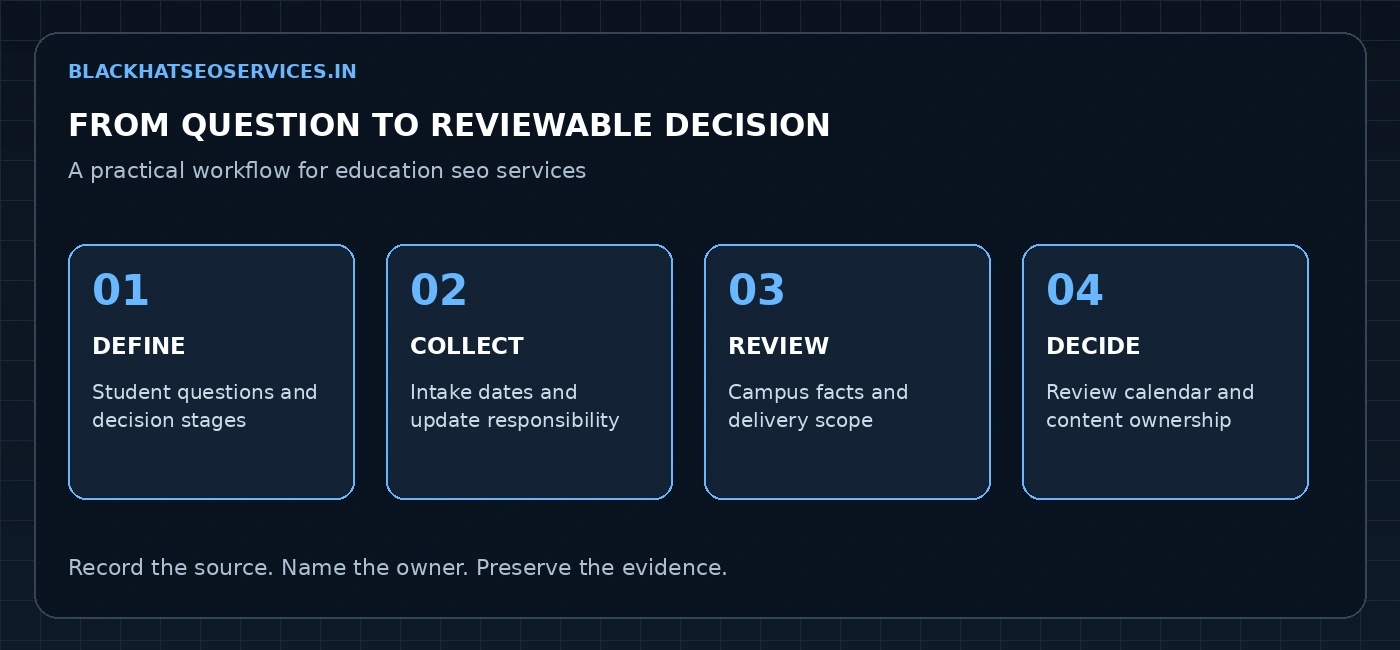
Practical Review Workflow
SEO Research and Practical Guidance
Improve the program navigation
Organize programs by meaningful learner choices such as subject, qualification level or study mode. Search visitors should be able to move from a broad interest to a specific program without guessing internal department names. Test navigation on mobile and with keyboard controls. Use descriptive links between related resources. A well-designed structure can reduce duplicate pages and make institutional updates easier to manage.
Related resource: B2B Seo Services India.
Evidence to retain
Navigation paths and category purpose. Check the proposed next action against the original reader or business need. An easy task is not necessarily a useful one. Explain the expected benefit in plain language so a reviewer can judge its relevance without relying on a tool score.
Ask a new reader to locate a suitable program using only the visible navigation.
SEO Research and Practical Guidance
Support local and remote intent honestly
A campus page should provide genuine location information, facilities and access guidance. An online program page should explain its delivery context and relevant limitations. Do not create dozens of interchangeable city pages for a program with no meaningful local distinction. Where locations differ, document the actual difference. The content should help applicants determine whether the option fits their circumstances.
Related resource: Black Hat Seo Services India Provider Review.
Evidence to retain
Campus facts and delivery scope. Preserve one example of a limitation as well as a successful observation. This makes the review more balanced and helps future users recognize where the process stops being reliable. Explain how that limitation affects the decision rather than hiding it in a general footnote.
State what genuinely changes between two location or study-mode pages.
SEO Research and Practical Guidance
Measure enquiries beyond form counts
Work with admissions staff to define a useful enquiry and track follow-up categories. A large number of unsuitable submissions can increase workload without improving recruitment. Connect page groups with the questions applicants ask and identify information that could resolve uncertainty earlier. Keep personal applicant information in appropriate institutional systems. Reporting can use aggregate outcomes without circulating detailed student records.
Related resource: Black Hat Seo Services.
Evidence to retain
Qualified enquiry definition and aggregate outcomes. Agree on the completion check before the work starts. The check should establish the intended behavior using evidence available to the reviewer. If the result is different from the plan, record the difference and decide whether the action needs revision.
Review a small anonymized sample of enquiries for recurring information gaps.
SEO Research and Practical Guidance
Create an institutional review cycle
Assign ownership for program facts, deadlines, fees and general guides. Plan reviews around intakes and known changes rather than relying on occasional website cleanups. Preserve a change log and redirect retired resources thoughtfully. The SEO supplier should provide a maintenance process the institution can continue. Accurate information and a usable journey remain valuable even when search demand changes seasonally.
Related resource: Ecommerce Technical Seo Services.
Evidence to retain
Review calendar and content ownership. Make the handover useful to the next person. Include the source, reasoning, decision and any maintenance trigger. A concise record with clear ownership is easier to continue than an unexplained collection of screenshots, links or exported rows.
Choose one intake and schedule all associated page reviews together.
SEO Research and Practical Guidance
Worked scenario: applying the review
Illustrative example. This is a planning exercise, not a reported client result.
Imagine a training provider whose program pages receive visits but generate many unsuitable enquiries. Admissions staff identify three recurring uncertainties: study mode, intake timing and the difference between two related programs. The website team maps these questions to the current journey and checks the approved institutional information. It discovers that an old guide links to an outdated intake section while a key program distinction appears only in a downloadable brochure.
The pilot updates one program cluster. The institutional reviewer confirms facts, the editor improves the explanation and the developer tests navigation and forms. Dates are assigned a clear owner so the next intake does not require guessing which pages contain duplicates. The guide remains educational and directs applicants to the correct current program information when they are ready for details.
The team reviews aggregate enquiry categories after publication. It looks for fewer avoidable misunderstandings and a clearer route to the appropriate next step, rather than assuming that more submissions always mean better recruitment. The handover includes the sources, owners and update triggers. This makes the improvement maintainable across future intakes and gives the SEO supplier a delivery standard grounded in student needs.
SEO Research and Practical Guidance
Build the working evidence file
Build the working brief around an education provider improving program discovery and admissions information. The required inputs are approved program records, intake details, student questions and aggregate enquiry feedback. Confirm their owners and definitions before allocating implementation work. The planned handover is a student-journey content plan with institutional review ownership, which connects analysis to an operational decision. Every recommendation needs a relevant example, a proposed action and an acceptance check. This allows a business stakeholder and a delivery specialist to review the same finding without relying on an unexplained score or a long list of tool warnings.
Use a simple record with an item identifier, the original source, the observation, the interpretation, the proposed action and the reviewer. For example, the first record in this guide concerns student questions and decision stages. Preserve the original evidence alongside the summary, because summaries can accidentally omit an important condition. Record missing information explicitly. An empty cell should mean the item has not yet been reviewed, while a completed review with insufficient evidence should have a written reason. Those are different states and should not be confused in a progress report.
Keep the file proportionate to the assignment. A small review may need only a few carefully documented rows. Adding hundreds of incomplete entries can make the work harder to prioritize. Ask the admissions lead and the institutional content reviewer to agree on the first decision the file must support, then collect only the information needed for that decision. Protect confidential material and use anonymized examples when the reasoning does not depend on identity. The aim is a reusable record that supports scrutiny, rather than a large archive nobody can interpret.
SEO Research and Practical Guidance
Plan a bounded pilot before committing
The suggested pilot is to review one program cluster from discovery guide through application instructions. State the starting condition and the expected output before beginning. Keep its scope small enough that you can inspect every important result. Do not use a favorable first observation as permission to expand into unrelated work. A pilot answers a defined question about usefulness, delivery or interpretation; it is not a miniature promise that the same outcome will hold at any scale. Record what the exercise deliberately leaves untested.
Set practical acceptance criteria. The output should address the reader or business task, expose supporting evidence and explain unresolved limitations. Assign the review to the admissions lead and the institutional content reviewer. Agree how defects or unanswered questions will be handled and who can authorize a revised scope. A review date is a checkpoint, not an instruction to invent certainty when the evidence is incomplete. If an essential input is unavailable, the correct result may be to pause the decision and obtain it, rather than proceed on a convenient assumption.
Use a stop condition as well as a success condition. In this case, a reason to stop or investigate is that marketing content contradicts the current approved program or intake information. Document that condition before the work begins so sunk effort does not become the reason to continue. Preserve useful partial findings, explain what would need to change and identify a smaller alternative if appropriate. This makes a declined opportunity or an inconclusive pilot a reviewable outcome. The process has value when it prevents an unjustified commitment as well as when it supports a sensible next step.
SEO Research and Practical Guidance
Measure effort, outcomes and uncertainty
The primary operating measures are qualified program enquiries, information accuracy and successful application-navigation tasks. Define the units, source and review period for each before comparing results. Keep completed work separate from observed performance. A deliverable can be verified directly, while an outcome may depend on demand, timing, other releases or actions outside the team's control. This distinction makes reporting more honest and useful: the reader can see both whether the team fulfilled the brief and what the available observations suggest about its wider value.
Consider this illustrative planning example: a guide that answers a common eligibility question can reduce unsuitable enquiries even if total form submissions fall. These figures describe a method of comparison, not an audited result or forecast. Replace them with actual records before using them to justify expenditure. Include staff time, review, cleanup and maintenance in the comparison. A low purchase price can conceal a substantial operating burden, while a more focused option may deliver a useful result with less recurring work. Write down the assumptions that would change the decision so the calculation can be revisited without reconstructing the whole discussion.
Review the quality of the evidence rather than only the direction of a chart. Check whether definitions stayed consistent, whether the sample represents the task and whether another event offers a plausible explanation. For education seo services, the evaluation should remain tied to the specific observations documented in this guide. If counts are small or access is limited, narrow the conclusion accordingly. Record what additional evidence would strengthen or overturn it. A careful uncertainty note tells the next reviewer where to focus, instead of using vague caution to avoid making any practical recommendation.
SEO Research and Practical Guidance
Turn the review into a maintainable decision
The final record should state the chosen action, why it fits the evidence and what remains unresolved. Deliver a student-journey content plan with institutional review ownership with its original inputs, dated observations and next review trigger. Identify the person responsible for maintaining the record. A decision that depends on a product version, publishing arrangement, institutional fact or website configuration can become stale when that dependency changes. The handover should make those dependencies visible, so a later reviewer knows what needs rechecking rather than assuming the original conclusion remains permanently valid.
Translate the review into a small set of owned tasks. Each task needs a specific output, a responsible person, necessary inputs and an acceptance check. Use the actions in the eight sections above as starting points rather than generic instructions to improve SEO. For example, revisit the evidence for review calendar and content ownership before expanding the work. If two tasks depend on the same unresolved question, resolve it once and share the result. This reduces repeated research and avoids different team members making contradictory assumptions about the same issue.
After implementation or procurement, verify the intended behavior and capture any differences from the plan. Review qualified program enquiries, information accuracy and successful application-navigation tasks at the agreed checkpoint and explain what the comparison can support. Keep useful unsuccessful findings, because they show which assumptions were tested and which approach should not be repeated without new evidence. A future update should improve the substance of the record, not merely refresh its visible date. The durable outcome is a clear, accountable process that another person can understand and continue when the original reviewer is no longer available.
SEO Research and Practical Guidance
Your printable review checklist
| Step | Evidence | Next action |
|---|---|---|
| 01 | Student questions and decision stages | List the ten questions admissions staff answer most frequently. |
| 02 | Program information owner and verification source | Compare one live page with the institution's current approved program information. |
| 03 | Intake dates and update responsibility | Identify every place a key deadline appears and assign one source of truth. |
| 04 | Approved fee information and conditions | Check whether an applicant can distinguish an example from a current offer. |
| 05 | Navigation paths and category purpose | Ask a new reader to locate a suitable program using only the visible navigation. |
| 06 | Campus facts and delivery scope | State what genuinely changes between two location or study-mode pages. |
| 07 | Qualified enquiry definition and aggregate outcomes | Review a small anonymized sample of enquiries for recurring information gaps. |
| 08 | Review calendar and content ownership | Choose one intake and schedule all associated page reviews together. |
Keep the source and review date beside each completed row. Use the full PDF for an offline copy of this guide.
SEO Research and Practical Guidance
Frequently asked questions
What should education SEO services deliver?
They should improve program discovery, information clarity and useful admissions journeys. Expected outputs include a content structure, verified program pages, technical corrections and a maintenance process. The scope should reflect the institution's actual audience and operating needs.
Which pages should be reviewed first?
Start with important program pages and the steps prospective students take before enquiring or applying. Check current facts, dates and navigation. A widely visited guide is useful, but inaccurate core program information can create more immediate confusion.
Who should verify program claims?
A responsible institutional reviewer should verify facts against approved records. The SEO writer or agency should not independently invent eligibility, accreditation or outcome claims. Define the reviewer and source before production begins.
Should every city get a separate page?
Only create a location page when it serves a genuine distinction, such as a campus or locally relevant delivery detail. Interchangeable city text can confuse applicants and increase maintenance. Explain real differences that affect the student's choice.
How should deadlines be maintained?
Use a clear source of truth and assign an owner. Track where dates are repeated and review content around intake changes. Archived material should be labeled so search visitors do not mistake an expired deadline for a current one.
Can fees be shown as examples?
Yes, when examples are unmistakably labeled and do not imply a current entitlement or offer. Link to the institution's approved current information where appropriate. Explain material conditions and obtain review from the team responsible for the figures.
What makes an education enquiry qualified?
Define it with admissions staff according to the program and institution. Relevance, eligibility questions and genuine study interest may matter more than raw submission volume. Use consistent categories so reporting supports practical decisions.
How can SEO reduce admissions workload?
Clear, accurate pages can answer recurring questions before an enquiry is submitted. Review anonymized enquiry themes to identify missing information. Measure whether the content helps applicants understand the next step and reduces avoidable clarification.
How should applicant data be used in reports?
Prefer aggregate categories and anonymized examples for content analysis. Keep detailed records in appropriate institutional systems and limit access. The marketing report usually does not need personal applicant information to identify common information gaps.
What should ongoing maintenance include?
Review program facts, intakes, fees, delivery modes, links and application paths. Assign owners and schedule checks around institutional changes. A supplier should hand over a process that staff can continue rather than leaving a collection of unowned pages.
SEO Research and Practical Guidance
Further reference material
Use current official documentation when verifying search terminology, technical requirements or platform policies.
SEO Research and Practical Guidance
Get the complete printable guide
Save the full article, worked scenario, checklist and all 10 FAQ answers for offline review.