Printable guide: Daily SERP Analytics: A Dashboard That Separates Signals from Noise
Daily SERP analytics is the routine review of search-result observations alongside your own search performance and business events.
Published 31 October 2026 · Updated 31 October 2026 · BlackHatSEOServices.in Editorial · 3,081 words · 15 min read
SEO Research and Practical Guidance
The practical starting point
Daily SERP analytics is the routine review of search-result observations alongside your own search performance and business events. Its purpose is to identify changes worth investigating, not to create a daily obligation to rewrite pages. A useful dashboard preserves the query, market, device, collection time and relevant page so that movement has context. This guide explains how to design a small monitoring set, choose alert rules and connect findings to actual decisions. It is intended for analysts and business owners who need a practical operating process rather than another collection of unqualified ranking charts.
SEO Research and Practical Guidance
Build a query panel around decisions
Choose a manageable group of queries representing important customer tasks. Separate branded, informational and commercial intent. Include the page expected to answer each query and the business reason for monitoring it. A list assembled solely from the largest impression counts may miss a small but valuable service query. Keep the panel stable enough to compare over time and record when its membership changes.
Related resource: Daily Serp Analytics Monitoring Decision Workflow.
Evidence to retain
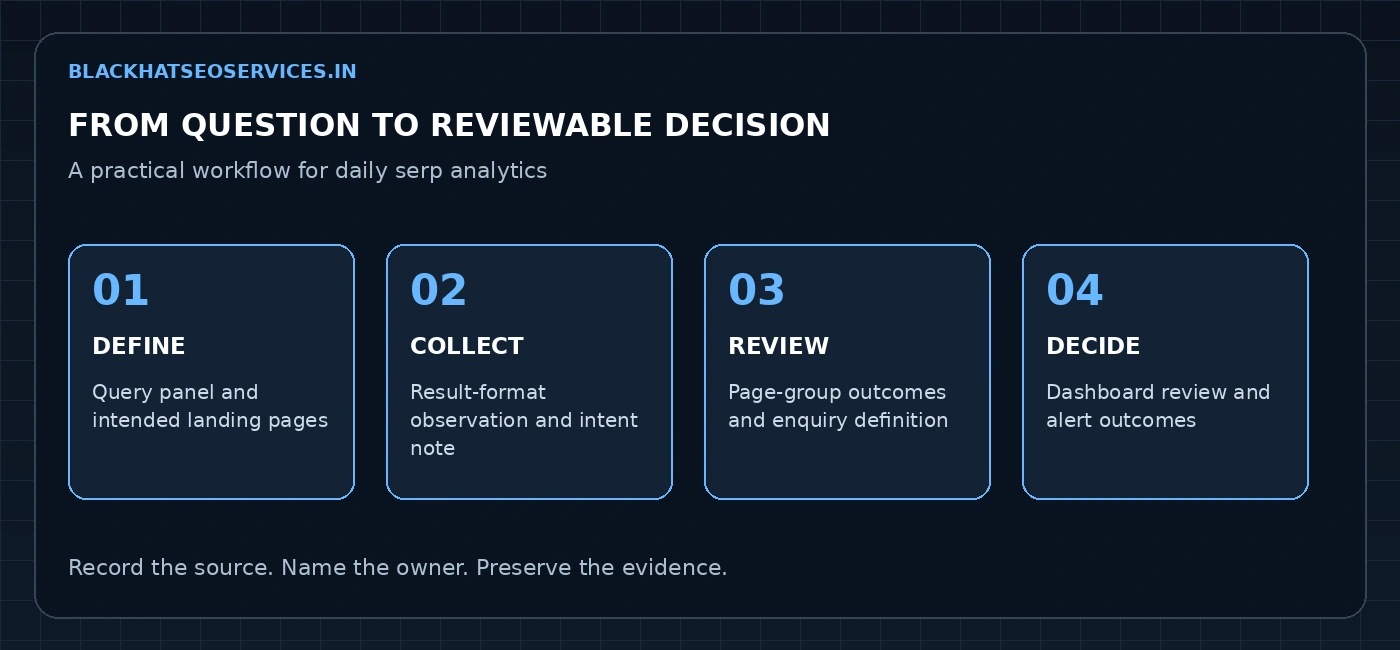
Query panel and intended landing pages. Record who supplied the information and what it directly demonstrates. Keep your interpretation separate from the original material. If the source is incomplete, mark the item for follow-up rather than silently treating the missing detail as a favorable answer.
Assign one business decision to each query group.
SEO Research and Practical Guidance
Keep collection conditions comparable
A result observed on one device or in one location cannot be treated as identical to a result collected elsewhere. Record market, language, device and collection time. Use authorized data sources and retain their definitions. If a provider changes collection methods, mark that event in the series. Apparent volatility can be a measurement change rather than a change in how customers see your site.
Related resource: Daily Serp Analytics.
Evidence to retain
Collection dimensions and provider method. Review a representative example before expanding the work. The example should match the actual task and preserve enough context for a second person to inspect it. A summary is useful only when the underlying observation remains available and understandable.
Check whether every observation includes the same required dimensions.
SEO Research and Practical Guidance
Track result features and intent shifts
Position alone does not describe the page a searcher sees. Note whether the result mix emphasizes video, local results, product pages or explanatory articles. A page may need a different format if the underlying intent has changed. Record observations in concise language and distinguish a one-day appearance from a persistent pattern. The aim is to understand the searcher's available choices, not simply count competitors.
Related resource: Serp Competitor Analysis.
Evidence to retain
Result-format observation and intent note. Name the person responsible for checking this item and record the review date. If the answer depends on a version, location or commercial arrangement, retain that condition. A finding that is true in one context may require a different decision elsewhere.
Describe the dominant page formats for a small representative sample.
SEO Research and Practical Guidance
Use alert thresholds that respect volume
A small ranking change can be ordinary fluctuation, especially for a low-volume query. Define thresholds using persistence, affected query groups and business importance rather than reacting to every movement. Separate a technical availability alert from a visibility trend alert. A broken key landing page may need immediate attention, while a modest position shift may only justify continued observation.
Related resource: What Is Serp Analysis.
Evidence to retain
Alert condition and response owner. Keep an unresolved-questions field beside the decision. This prevents a provisional interpretation from becoming an assumed fact during handover. Identify the smallest additional observation that would resolve the uncertainty before authorizing a larger commitment.
Write the action that should follow each alert before enabling it.
Practical Review Workflow
SEO Research and Practical Guidance
Connect search observations with site events
Maintain a change log for releases, content revisions, redirects and campaigns. Place those events alongside the dashboard timeline. This helps the analyst generate plausible explanations without assuming that the closest event caused the movement. Also record measurement changes and known outages. A short, accurate event log often explains more than a visually elaborate dashboard with no operational context.
Related resource: Seo Competitor Analysis Services.
Evidence to retain
Release log and campaign timeline. Check the proposed next action against the original reader or business need. An easy task is not necessarily a useful one. Explain the expected benefit in plain language so a reviewer can judge its relevance without relying on a tool score.
Ask the website team to record the next release in a consistent format.
SEO Research and Practical Guidance
Separate visibility from business outcomes
Search observations can identify exposure, but the business cares about useful visits, enquiries and transactions. Connect the relevant page group to the available outcome measurement without pretending every visitor can be individually attributed. Discuss lead quality with the team handling enquiries. A visibility gain that sends users to an unsuitable page may not improve commercial performance.
Related resource: Seo Competitor Keyword Analysis.
Evidence to retain
Page-group outcomes and enquiry definition. Preserve one example of a limitation as well as a successful observation. This makes the review more balanced and helps future users recognize where the process stops being reliable. Explain how that limitation affects the decision rather than hiding it in a general footnote.
Review one landing page's search movement alongside its customer journey.
SEO Research and Practical Guidance
Create a short daily triage routine
Start with availability and measurement health, then review persistent or widespread changes. Log issues that need investigation and leave ordinary noise alone. Assign owners and review dates so the same unexplained movement is not discussed every morning. Keep the daily note concise; deeper analysis belongs in a separate investigation. The routine should reduce decision effort, not become a reporting ritual without action.
Related resource: Ai Overview Optimization Services.
Evidence to retain
Triage note and investigation queue. Agree on the completion check before the work starts. The check should establish the intended behavior using evidence available to the reviewer. If the result is different from the plan, record the difference and decide whether the action needs revision.
Limit the daily summary to changes that justify a next step.
SEO Research and Practical Guidance
Review the dashboard itself monthly
Remove unused panels and investigate missing fields. Check whether alerts led to useful decisions or only interrupted the team. Revisit the query panel when services or customer priorities change, keeping a record of the revision. A dashboard is a product with users and maintenance needs. Its success is the quality and speed of decisions it supports, rather than the number of charts it contains.
Related resource: Ai Search Visibility Audit Service.
Evidence to retain
Dashboard review and alert outcomes. Make the handover useful to the next person. Include the source, reasoning, decision and any maintenance trigger. A concise record with clear ownership is easier to continue than an unexplained collection of screenshots, links or exported rows.
Retire one metric that nobody uses to make a decision.
SEO Research and Practical Guidance
Worked scenario: applying the review
Illustrative example. This is a planning exercise, not a reported client result.
Imagine an analyst responsible for a small service website. The initial dashboard tracks hundreds of phrases and produces frequent alerts, but the team cannot explain which changes require action. The analyst replaces that list with a stable panel of customer tasks, known landing pages and consistent collection dimensions. Each alert receives a named response owner and a reason to exist. Technical availability is reviewed separately from ordinary visibility movement.
During the pilot, one query fluctuates for a day while a related group declines persistently after a site release. The first observation is logged without intervention. The second opens an investigation that compares the release record, affected pages and measurement health. The dashboard does not declare the release guilty; it supplies enough context to ask a precise question. The investigation then gathers the evidence needed to confirm or reject that hypothesis.
At the end of the pilot, the team reviews which alerts led to useful decisions. Unused panels are removed and collection limitations are documented. The daily routine becomes shorter while its outputs become more actionable. The dashboard's value is demonstrated through faster understanding and better ownership, not through the number of charts displayed. Search observations remain connected to qualified page-group outcomes rather than being treated as a complete business report.
SEO Research and Practical Guidance
Build the working evidence file
Build the working brief around an analyst building a daily search monitoring routine. The required inputs are a defined query panel, consistent observations, site events and page-group outcomes. Confirm their owners and definitions before allocating implementation work. The planned handover is a daily triage dashboard with documented alert rules, which connects analysis to an operational decision. Every recommendation needs a relevant example, a proposed action and an acceptance check. This allows a business stakeholder and a delivery specialist to review the same finding without relying on an unexplained score or a long list of tool warnings.
Use a simple record with an item identifier, the original source, the observation, the interpretation, the proposed action and the reviewer. For example, the first record in this guide concerns query panel and intended landing pages. Preserve the original evidence alongside the summary, because summaries can accidentally omit an important condition. Record missing information explicitly. An empty cell should mean the item has not yet been reviewed, while a completed review with insufficient evidence should have a written reason. Those are different states and should not be confused in a progress report.
Keep the file proportionate to the assignment. A small review may need only a few carefully documented rows. Adding hundreds of incomplete entries can make the work harder to prioritize. Ask the search analyst and the website release owner to agree on the first decision the file must support, then collect only the information needed for that decision. Protect confidential material and use anonymized examples when the reasoning does not depend on identity. The aim is a reusable record that supports scrutiny, rather than a large archive nobody can interpret.
SEO Research and Practical Guidance
Plan a bounded pilot before committing
The suggested pilot is to monitor a small stable query group for two weeks before expanding coverage. State the starting condition and the expected output before beginning. Keep its scope small enough that you can inspect every important result. Do not use a favorable first observation as permission to expand into unrelated work. A pilot answers a defined question about usefulness, delivery or interpretation; it is not a miniature promise that the same outcome will hold at any scale. Record what the exercise deliberately leaves untested.
Set practical acceptance criteria. The output should address the reader or business task, expose supporting evidence and explain unresolved limitations. Assign the review to the search analyst and the website release owner. Agree how defects or unanswered questions will be handled and who can authorize a revised scope. A review date is a checkpoint, not an instruction to invent certainty when the evidence is incomplete. If an essential input is unavailable, the correct result may be to pause the decision and obtain it, rather than proceed on a convenient assumption.
Use a stop condition as well as a success condition. In this case, a reason to stop or investigate is that alerts fire repeatedly but have no owner or defined response. Document that condition before the work begins so sunk effort does not become the reason to continue. Preserve useful partial findings, explain what would need to change and identify a smaller alternative if appropriate. This makes a declined opportunity or an inconclusive pilot a reviewable outcome. The process has value when it prevents an unjustified commitment as well as when it supports a sensible next step.
SEO Research and Practical Guidance
Measure effort, outcomes and uncertainty
The primary operating measures are useful investigations opened, time to identify issues and qualified page-group outcomes. Define the units, source and review period for each before comparing results. Keep completed work separate from observed performance. A deliverable can be verified directly, while an outcome may depend on demand, timing, other releases or actions outside the team's control. This distinction makes reporting more honest and useful: the reader can see both whether the team fulfilled the brief and what the available observations suggest about its wider value.
Consider this illustrative planning example: a one-day move from position eight to ten is weaker evidence than a week-long decline across several related service queries. These figures describe a method of comparison, not an audited result or forecast. Replace them with actual records before using them to justify expenditure. Include staff time, review, cleanup and maintenance in the comparison. A low purchase price can conceal a substantial operating burden, while a more focused option may deliver a useful result with less recurring work. Write down the assumptions that would change the decision so the calculation can be revisited without reconstructing the whole discussion.
Review the quality of the evidence rather than only the direction of a chart. Check whether definitions stayed consistent, whether the sample represents the task and whether another event offers a plausible explanation. For daily serp analytics, the evaluation should remain tied to the specific observations documented in this guide. If counts are small or access is limited, narrow the conclusion accordingly. Record what additional evidence would strengthen or overturn it. A careful uncertainty note tells the next reviewer where to focus, instead of using vague caution to avoid making any practical recommendation.
SEO Research and Practical Guidance
Turn the review into a maintainable decision
The final record should state the chosen action, why it fits the evidence and what remains unresolved. Deliver a daily triage dashboard with documented alert rules with its original inputs, dated observations and next review trigger. Identify the person responsible for maintaining the record. A decision that depends on a product version, publishing arrangement, institutional fact or website configuration can become stale when that dependency changes. The handover should make those dependencies visible, so a later reviewer knows what needs rechecking rather than assuming the original conclusion remains permanently valid.
Translate the review into a small set of owned tasks. Each task needs a specific output, a responsible person, necessary inputs and an acceptance check. Use the actions in the eight sections above as starting points rather than generic instructions to improve SEO. For example, revisit the evidence for dashboard review and alert outcomes before expanding the work. If two tasks depend on the same unresolved question, resolve it once and share the result. This reduces repeated research and avoids different team members making contradictory assumptions about the same issue.
After implementation or procurement, verify the intended behavior and capture any differences from the plan. Review useful investigations opened, time to identify issues and qualified page-group outcomes at the agreed checkpoint and explain what the comparison can support. Keep useful unsuccessful findings, because they show which assumptions were tested and which approach should not be repeated without new evidence. A future update should improve the substance of the record, not merely refresh its visible date. The durable outcome is a clear, accountable process that another person can understand and continue when the original reviewer is no longer available.
SEO Research and Practical Guidance
Your printable review checklist
| Step | Evidence | Next action |
|---|---|---|
| 01 | Query panel and intended landing pages | Assign one business decision to each query group. |
| 02 | Collection dimensions and provider method | Check whether every observation includes the same required dimensions. |
| 03 | Result-format observation and intent note | Describe the dominant page formats for a small representative sample. |
| 04 | Alert condition and response owner | Write the action that should follow each alert before enabling it. |
| 05 | Release log and campaign timeline | Ask the website team to record the next release in a consistent format. |
| 06 | Page-group outcomes and enquiry definition | Review one landing page's search movement alongside its customer journey. |
| 07 | Triage note and investigation queue | Limit the daily summary to changes that justify a next step. |
| 08 | Dashboard review and alert outcomes | Retire one metric that nobody uses to make a decision. |
Keep the source and review date beside each completed row. Use the full PDF for an offline copy of this guide.
SEO Research and Practical Guidance
Frequently asked questions
What is daily SERP analytics?
It is a routine for reviewing search-result observations in context. A useful process records query, market, device and time, then connects changes with site events and business needs. The purpose is better decisions, not constant page editing.
Should I react to every ranking change?
No. Define thresholds based on persistence, scope and importance. Small movements may be ordinary noise. Availability problems can need immediate attention, while a modest visibility change often deserves observation before the team commits to an intervention.
Which keywords belong in the dashboard?
Choose queries that represent important customer tasks and known landing pages. Separate branded and generic intent. Include commercial relevance as well as volume, and retain a record of changes to the monitoring panel.
Why do device and location matter?
Search observations depend on collection conditions. A change in device, market or language can create an apparent movement that is not a like-for-like comparison. Preserve these dimensions so the series can be interpreted responsibly.
What should a useful alert contain?
It should state the condition, affected query or page group, supporting evidence, response owner and next action. Distinguish technical incidents from trend investigations. An alert without a defined response usually adds noise rather than improving operations.
Can a dashboard prove why rankings changed?
Usually not on its own. It helps identify timing and patterns, but several causes may fit the same observation. Use the dashboard to guide investigation and retain alternative explanations until stronger evidence supports a conclusion.
How should site releases be tracked?
Keep a concise dated log of changes, affected templates or pages and responsible owners. Include measurement changes and outages. Place the log beside search observations so analysts can investigate relationships without relying on memory.
What business metrics should accompany visibility?
Use outcomes relevant to the page group, such as qualified enquiries or useful transactions. Keep definitions consistent with the sales team. Visibility is one part of the journey and should not be mistaken for completed business value.
How long should daily review take?
Keep it proportionate to the site and workload. A small panel may support a brief triage routine, with deeper investigations handled separately. If review time grows without producing useful actions, simplify the dashboard and alert rules.
When should the dashboard be revised?
Review it when services, customer priorities or data sources change, and inspect its usefulness periodically. Keep a revision log. Remove metrics that do not support decisions and preserve enough consistency to understand historical comparisons.
SEO Research and Practical Guidance
Further reference material
Use current official documentation when verifying search terminology, technical requirements or platform policies.
SEO Research and Practical Guidance
Get the complete printable guide
Save the full article, worked scenario, checklist and all 10 FAQ answers for offline review.